Electrical Energy Calculator
Calculate electricity use from power and duration, or constant DC voltage and current. Compare energy use over different operating times in watt-hours, kilowatt-hours and joules.
Open tool
Interactive calculation is unavailable until JavaScript loads. The formulas, worked examples and references below remain available.
Estimate the inductance of a single-layer air-core coil (solenoid) from its diameter, length and turns, or the turns for a target inductance.
Choose Inductance from turns or Turns for an inductance, and the length unit.
Enter the coil diameter measured to the wire centres.
Choose Winding length and enter it, or Turn pitch for a close-wound coil and enter the wire diameter.
Enter the turns, or the target inductance and its unit.
Read the inductance or turns, Nagaoka's factor, the long-coil value and the wire length.
Copy result copies labeled values; Reset restores the starting fields.
A long coil's inductance is μ0 × π r² N² / l: it grows with the square of the turns and the area, and falls with length. Real coils are not infinitely long; near the ends the field spreads out, so the inductance is lower by a factor K that depends only on the diameter-to-length ratio.
Nagaoka tabulated K in 1909 from Lorenz's exact formula for a current sheet. This tool computes K directly from the same formula with complete elliptic integrals, so it is accurate for any length, from a long solenoid (K near 1) to a short wide loop (K = 0.203 at a diameter ten times the length).
The long-solenoid formula assumes the coil is much longer than its diameter. Nagaoka's factor corrects for the ends; at D/l = 10 it is only 0.203, so the long-coil value is nearly five times too high.
Measure the diameter to the centre of the wire and the length as turns × pitch. For a close-wound coil the pitch is the wire's outside diameter. With fewer than about five turns, or a coil much shorter than its diameter, a current sheet is a rough model of round wire.
Limitations: the result is the low-frequency inductance of a single-layer coil in air. It ignores the round-wire and spacing corrections, the coil's self-capacitance and self-resonance, skin and proximity effects at high frequency, and nearby metal or cores. Expect a real coil to differ by a few percent; measure it when it matters.
Long coil: L∞ = μ0 × π × r² × N² / l. μ0 = 1.25663706127e-6 H/m, r = D / 2, l = winding length.
Nagaoka: L = K × L∞, with k = D / √(D² + l²) and k' = l / √(D² + l²): K = (4 / (3π k')) × ((k'² / k²) × (K(k) − E(k)) + E(k) − k).
Elliptic integrals: K(k) and E(k) are evaluated by the arithmetic-geometric mean of 1 and k'.
Turns, fixed length: N = √(L × l / (μ0 × π × r² × K)).
Pitch: l = N × p; the turns are solved numerically because K changes with N.
Wire length: N × √((π × D)² + p²), where p = l / N.
Diameter 20 mm, length 20 mm, 20 turns: 5.436 μH. D/l = 1, so K = 0.688423; the long-coil value 7.896 μH times K.
Diameter 1 in, length 2 in, 40 turns: 16.41 μH. D/l = 0.5 and K = 0.818136; Nagaoka's end correction reduces the long-solenoid value of 20.055 μH.
Turns for 10 μH, diameter 20 mm, length 20 mm: 27.127 turns. N = √(L × l / (μ0 π r² K)). 27 turns give 9.906 μH and 28 turns 10.65 μH.
Turns for 1 μH, diameter 10 mm, close-wound 0.5 mm wire: 9.753 turns, 4.876 mm long. The length grows with the turns, so N is solved numerically. 9 turns give 888.4 nH and 10 turns 1.037 μH.
Diameter 100 mm, length 10 mm, 5 turns: 5.017 μH, not 24.67 μH. Common mistake: the long-coil formula ignores the ends. At D/l = 10, K = 0.203324.
20 mm former, 1 mm wire, 20 mm long, 20 turns: 5.899 μH with D = 21 mm. Common mistake: using the former diameter (20 mm) understates L by about 8 %; measure to the wire centres.
Rosa and Grover: Formulas and tables for the calculation of mutual and self-inductance (NIST)
NIST DLMF §19.8: Complete elliptic integrals by the AGM
Available now
Calculate electricity use from power and duration, or constant DC voltage and current. Compare energy use over different operating times in watt-hours, kilowatt-hours and joules.
Open tool →Available now
Add up to 20 resistors in series using Ω, kΩ or MΩ for circuit analysis and electricity calculations, with a diagram and running total.
Open tool →Available now
Convert absolute temperatures between Celsius, Fahrenheit and kelvin.
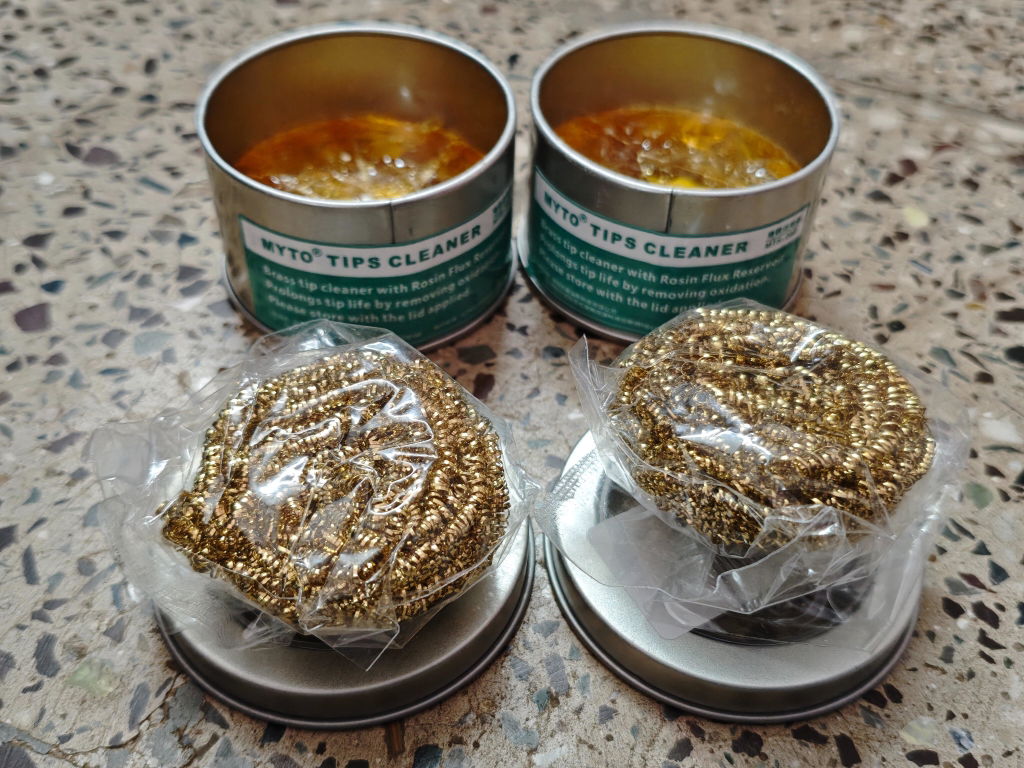
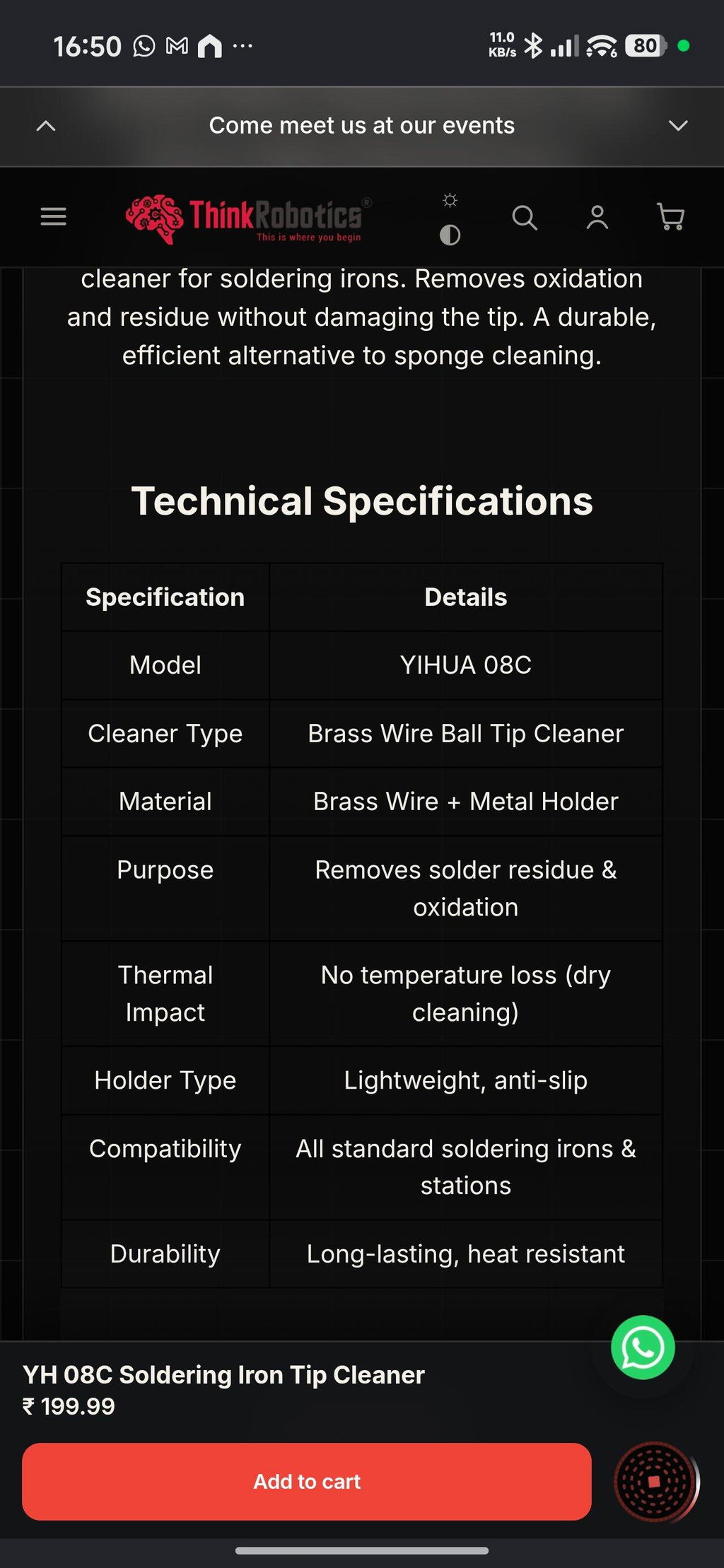
Open tool →Given the fact that this was my first purchase and I made it thinking I was buying genuine Yihua products, this has been a setback. I received a lesser known OEM brand called MYTO and while both the products seem to be similar from appearance, my real contention is the quality and quantity of the brass wool. On top of that not informing the customer about the unavailability of the Yihua product and instead sending a product from a different brand is also antagonising. Henceforth, I might just have to think twice before ordering from ThinkRobotics.
TOF MINIF Range Sensor - UART TOF Time-of-Flight Laser Range Sensor
We are disappointed with our recent order experience. We clearly communicated our requirement for 433 MHz antennas on WhatsApp, but the issue remains unresolved. We have been following up for more than 10 days and are still waiting for a proper refund resolution.
As a regular B2B customer, we expected better support. This experience has affected our trust in ThinkRobotics, and we may have to consider other suppliers for future purchases. We request a fair and prompt refund.
Anodised Aluminium Cup Head Washers (Pack of 10)