Electrical Energy Calculator
Calculate electricity use from power and duration, or constant DC voltage and current. Compare energy use over different operating times in watt-hours, kilowatt-hours and joules.
Open tool
Interactive calculation is unavailable until JavaScript loads. The formulas, worked examples and references below remain available.
Check an LED string against a constant-current driver's output voltage range, or size the ballast resistor for parallel strings on a constant-voltage supply.
Choose Constant-current driver or Constant-voltage supply.
Enter the LEDs in series per string and the number of strings in parallel.
Enter the typical forward voltage, and the maximum if the data sheet gives one.
For a constant-current driver, enter its output current and its lowest and highest regulating voltages. Optionally enter the LED's maximum current.
For a constant-voltage supply, enter the supply voltage and the current you want in each string.
Read the fit or ballast resistor, currents, powers and scale. Copy result copies the labeled values. Reset restores the starting fields.
LEDs in series carry the same current, so a string's voltage is the sum of the forward voltages. A constant-current driver sets the current and lets the voltage float within the output-voltage range on its data sheet. Above that range the driver cannot reach its current; below it many drivers stop regulating.
Forward voltage varies from LED to LED and with current and temperature, so check the string at both the typical and the maximum forward voltage. The longer the string, the wider the spread the driver must cover.
Strings in parallel on one driver do not share current equally. The string with the lowest total forward voltage takes the most current, warms up and takes still more as its forward voltage falls. If one LED fails open, the whole driver current flows through the remaining strings. Matching or binning forward voltage, or one regulator per string, avoids this.
On a fixed-voltage supply, a resistor in each string sets the current from the voltage left over after the LEDs. More voltage across the resistor makes the current less sensitive to forward-voltage spread but wastes more power. Choose a resistor at or above the calculated value, rated for at least twice its power. A higher supply voltage or lower LED forward voltage can increase the current.
Limitations: the tool assumes equal current sharing between parallel strings and one forward voltage per LED at the drive current. It does not model the driver's efficiency, input power, current accuracy, dimming, ripple current, thermal design or fault protection, and suggests no standard resistor values.
String voltage: V_str = s × V_F. Check s × V_F,typ and s × V_F,max.
Driver fit: V_DRV,min ≤ s × V_F,typ and s × V_F,max ≤ V_DRV,max.
LEDs per string that fit: s_min = ceil(V_DRV,min ÷ V_F,typ); s_max = floor(V_DRV,max ÷ V_F,max).
Current per string: I_str = I_DRV ÷ p; with one string open, I_DRV ÷ (p - 1).
Ballast resistor: R_B = (V_S - s × V_F,typ) ÷ I_F.
Resistor power: P_R = (V_S - s × V_F,typ) × I_F; rating ≥ 2 × P_R.
Efficiency: η = s × V_F,typ ÷ V_S.
700 mA driver rated 9-48 V, 12 LEDs at 3.0 V typical and 3.4 V maximum: Fits: 36 V to 40.8 V; 3 to 14 LEDs fit. 12 × 3.0 = 36 V and 12 × 3.4 = 40.8 V, both inside 9-48 V. LED power is 25.2 W to 28.56 W, inside the driver's 33.6 W rating.
Same driver, 16 LEDs: Above range: 48 V to 54.4 V. Checking only the typical forward voltage misses a limit. At 3.0 V the string fits, but at 3.4 V it needs 54.4 V and the driver cannot reach 700 mA.
Same driver, 2 strings of 12 LEDs, LED maximum 500 mA: 350 mA per string; 700 mA if one string opens. Equal sharing gives 350 mA, but an open LED sends 700 mA through the other string, above its 500 mA rating.
24 V supply, 6 LEDs at 3.0 V (3.2 V maximum), 20 mA: R_B = 300 Ω, P_R = 120 mW. 6 V is left for the resistor. Efficiency is 75 %; a string at 3.2 V per LED runs at 16 mA.
12 V supply, 4 LEDs at 3.1 V: No solution. 4 × 3.1 = 12.4 V is above the supply. Use 3 LEDs per string or a higher supply.
Texas Instruments AN-1656: Design Challenges of Switching LED Drivers
Mean Well LPC-35 series LED driver specification
Avago (Broadcom) Application Note 1005: Operational Considerations for LED Lamps and Display Devices
OpenStax University Physics Volume 2: 9.5 Electrical Energy and Power
Available now
Calculate electricity use from power and duration, or constant DC voltage and current. Compare energy use over different operating times in watt-hours, kilowatt-hours and joules.
Open tool →Available now
Add up to 20 resistors in series using Ω, kΩ or MΩ for circuit analysis and electricity calculations, with a diagram and running total.
Open tool →Available now
Convert absolute temperatures between Celsius, Fahrenheit and kelvin.
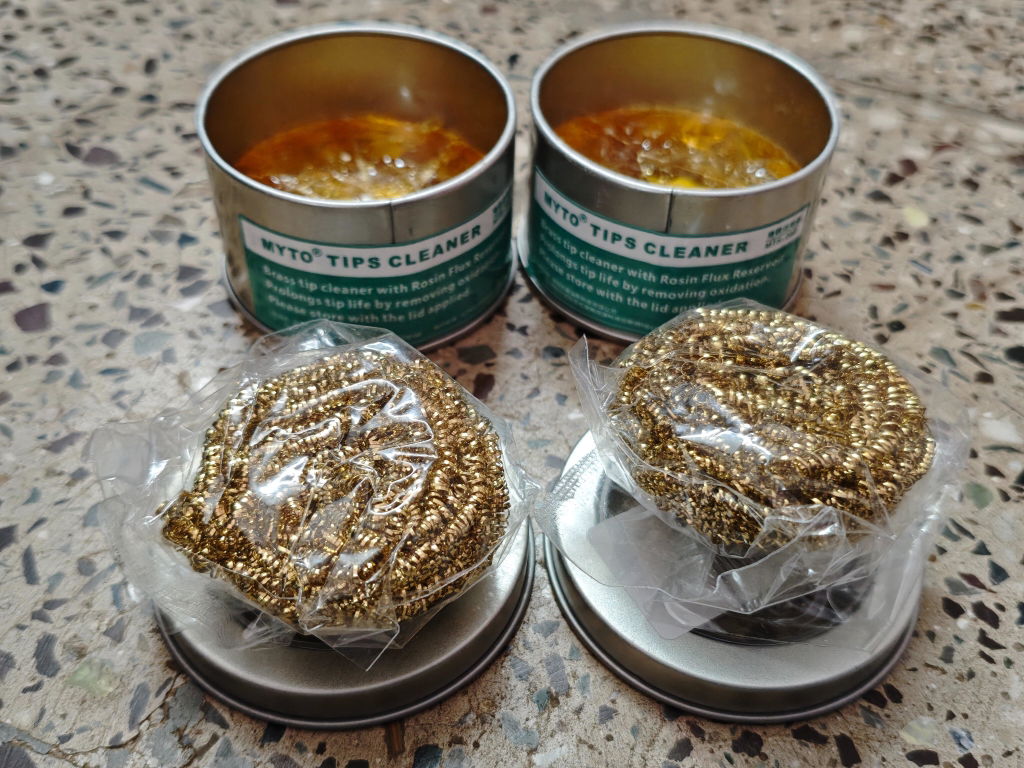
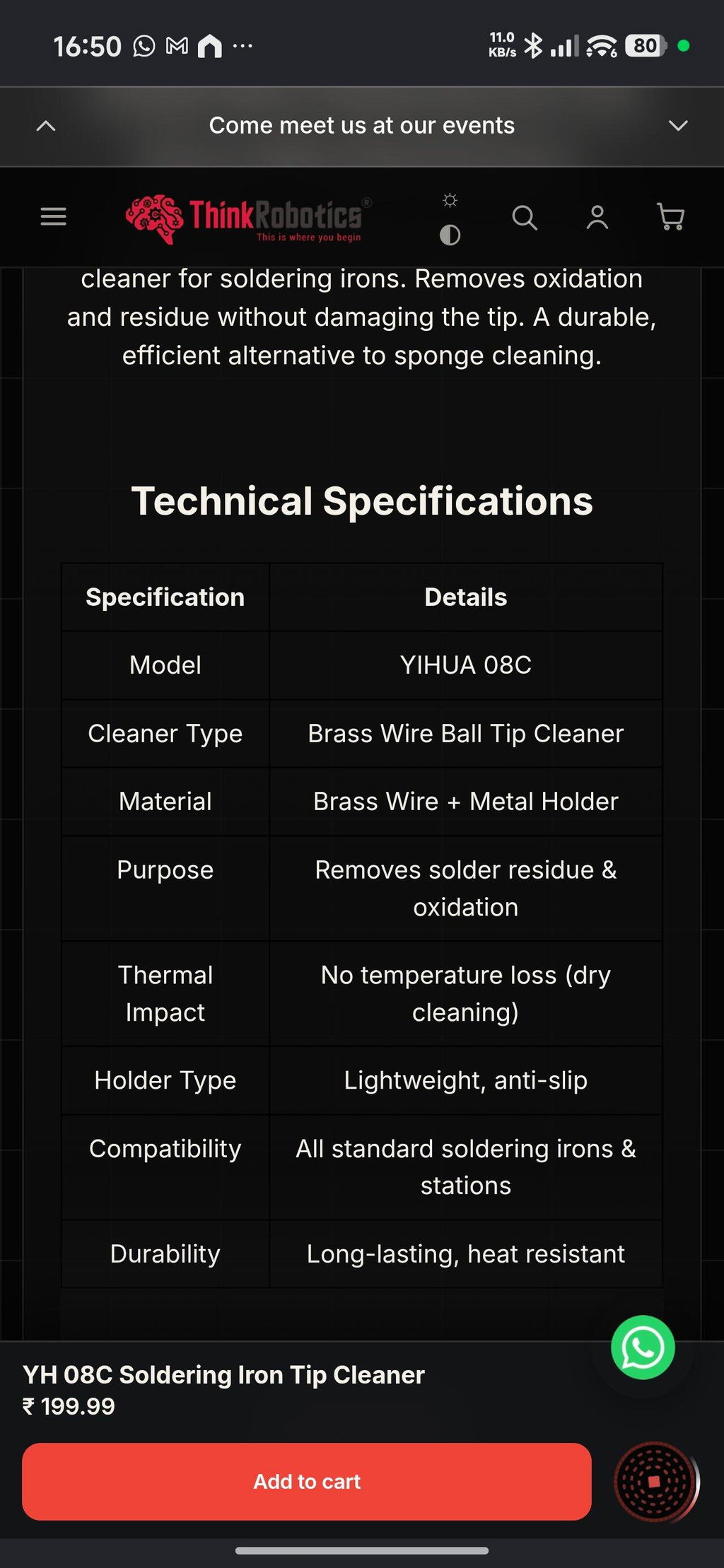
Open tool →Given the fact that this was my first purchase and I made it thinking I was buying genuine Yihua products, this has been a setback. I received a lesser known OEM brand called MYTO and while both the products seem to be similar from appearance, my real contention is the quality and quantity of the brass wool. On top of that not informing the customer about the unavailability of the Yihua product and instead sending a product from a different brand is also antagonising. Henceforth, I might just have to think twice before ordering from ThinkRobotics.
TOF MINIF Range Sensor - UART TOF Time-of-Flight Laser Range Sensor
We are disappointed with our recent order experience. We clearly communicated our requirement for 433 MHz antennas on WhatsApp, but the issue remains unresolved. We have been following up for more than 10 days and are still waiting for a proper refund resolution.
As a regular B2B customer, we expected better support. This experience has affected our trust in ThinkRobotics, and we may have to consider other suppliers for future purchases. We request a fair and prompt refund.
Anodised Aluminium Cup Head Washers (Pack of 10)