Electrical Energy Calculator
Calculate electricity use from power and duration, or constant DC voltage and current. Compare energy use over different operating times in watt-hours, kilowatt-hours and joules.
Open tool
Interactive calculation is unavailable until JavaScript loads. The formulas, worked examples and references below remain available.
Convert NTC thermistor resistance to temperature and back with the Beta or Steinhart-Hart model, and find the output voltage of a thermistor divider.
Choose a task: resistance or divider voltage to temperature, or temperature to resistance or divider voltage.
Choose Beta and enter the resistance at the reference temperature and the B value, or choose Steinhart-Hart and enter A, B and C.
For a divider, enter the supply voltage and series resistor and choose where the thermistor sits.
Enter the resistance, voltage or temperature with its unit.
Read the result, the sensitivity and, for a divider, the current, power and output slope. Copy result copies labeled values; Reset restores the starting fields.
An NTC thermistor's resistance falls steeply and nonlinearly as it warms, by about 4 % per kelvin near room temperature. A datasheet describes the curve either with a resistance at 25 °C and a B value, or with Steinhart-Hart coefficients fitted to measured points.
The Beta model is exact only at its two measurement temperatures (for example 25 and 85 °C for B25/85); between and beyond them it drifts by tenths of a degree or more. The three-term Steinhart-Hart fit follows the real curve to a few millikelvin over the range it was fitted to. Both formulas need absolute temperature in kelvin: putting 25 instead of 298.15 into the Beta formula gives nonsense.
A thermistor is usually read in a divider with a fixed series resistor. The output is most sensitive near the temperature where the thermistor equals the series resistor. The divider current also heats the thermistor; dividing the power by the dissipation constant from the datasheet gives the error this causes.
Limitations: the tool uses the model values you enter and does not know any particular part. It assumes an ideal supply and an unloaded divider output, ignores self-heating, tolerance and lead resistance, and does not convert to ADC counts. Steinhart-Hart coefficients fitted with resistance in kilohms do not work with ohms. Results outside -100 to 300 °C are not reported.
Kelvin: T = t + 273.15; t in °C, T in K.
Beta: R = R0 × exp(B × (1/T - 1/T0)); T = 1 / (1/T0 + ln(R/R0) / B).
Steinhart-Hart: 1/T = A + B × ln(R) + C × ln(R)^3, R in ohms.
Steinhart-Hart inverse: x = (A - 1/T)/C; y = sqrt((B/(3C))^3 + x^2/4); R = exp(cbrt(y - x/2) - cbrt(y + x/2)).
Divider (thermistor to ground): Vout = Vs × R / (Rs + R); R = Rs × Vout / (Vs - Vout).
Sensitivity: α = -B / T^2 (Beta); α = -1 / (T^2 × (B + 3C × ln(R)^2)) (Steinhart-Hart).
Beta: 10 kΩ at 25 °C, B 3950 K, resistance 5 kΩ: 41.460 °C. 1 / (1/298.15 + ln(0.5)/3950) - 273.15.
Steinhart-Hart: A 1.1384e-3, B 2.3245e-4, C 9.489e-8; resistance 10,021 Ω: 25.000 °C (24.9996 °C). SRS's fitted coefficients reproduce their 25 °C calibration point.
Divider: same 10 kΩ, B 3950 K thermistor to ground, 10 kΩ series resistor, 3.3 V, 25 °C: 1.65 V; slope -36.66 mV/K; 272.25 μW. Equal resistances give half the supply and the steepest output.
Common mistake: kelvin: Using 25 instead of 298.15 K in the Beta formula with 5 kΩ gives 25.11, not 41.46 °C. The Beta formula needs absolute temperature.
TDK: Digital readout and trimming of NTC thermistors
TDK: NTC thermistors, symbols and terms
Vishay: NTC thermistors application note
SRS LDC Note 4: Steinhart-Hart coefficients
Steinhart and Hart (1968), Calibration curves for thermistors
Available now
Calculate electricity use from power and duration, or constant DC voltage and current. Compare energy use over different operating times in watt-hours, kilowatt-hours and joules.
Open tool →Available now
Add up to 20 resistors in series using Ω, kΩ or MΩ for circuit analysis and electricity calculations, with a diagram and running total.
Open tool →Available now
Convert absolute temperatures between Celsius, Fahrenheit and kelvin.
Open tool →Nice audio board working as expected.
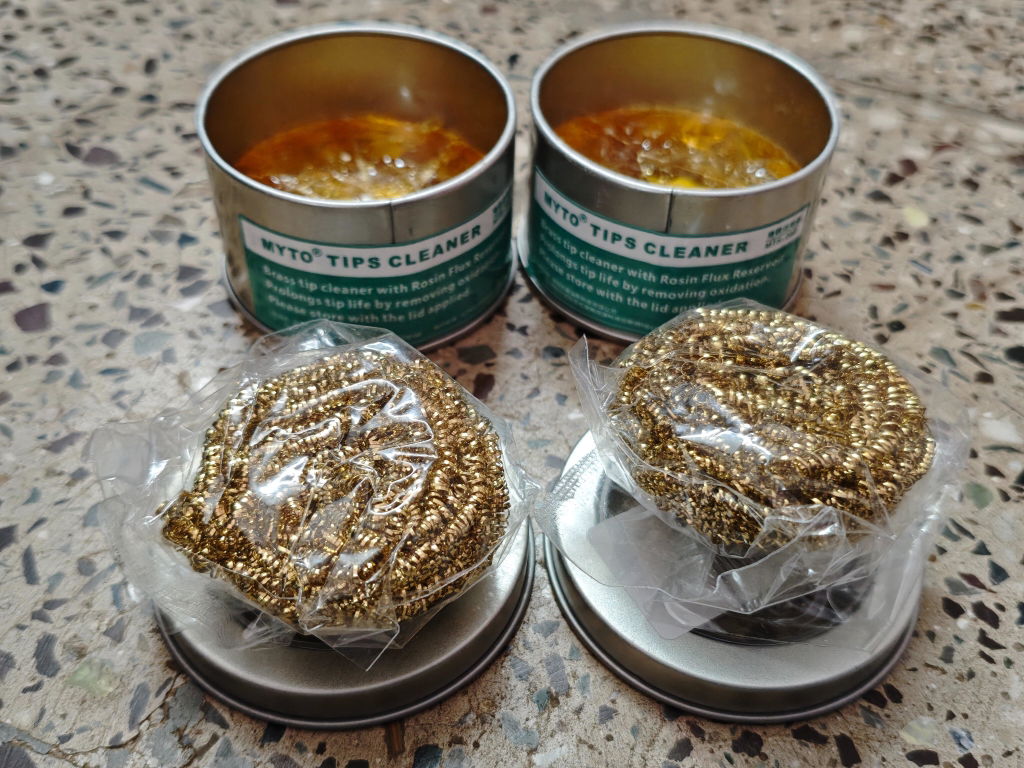
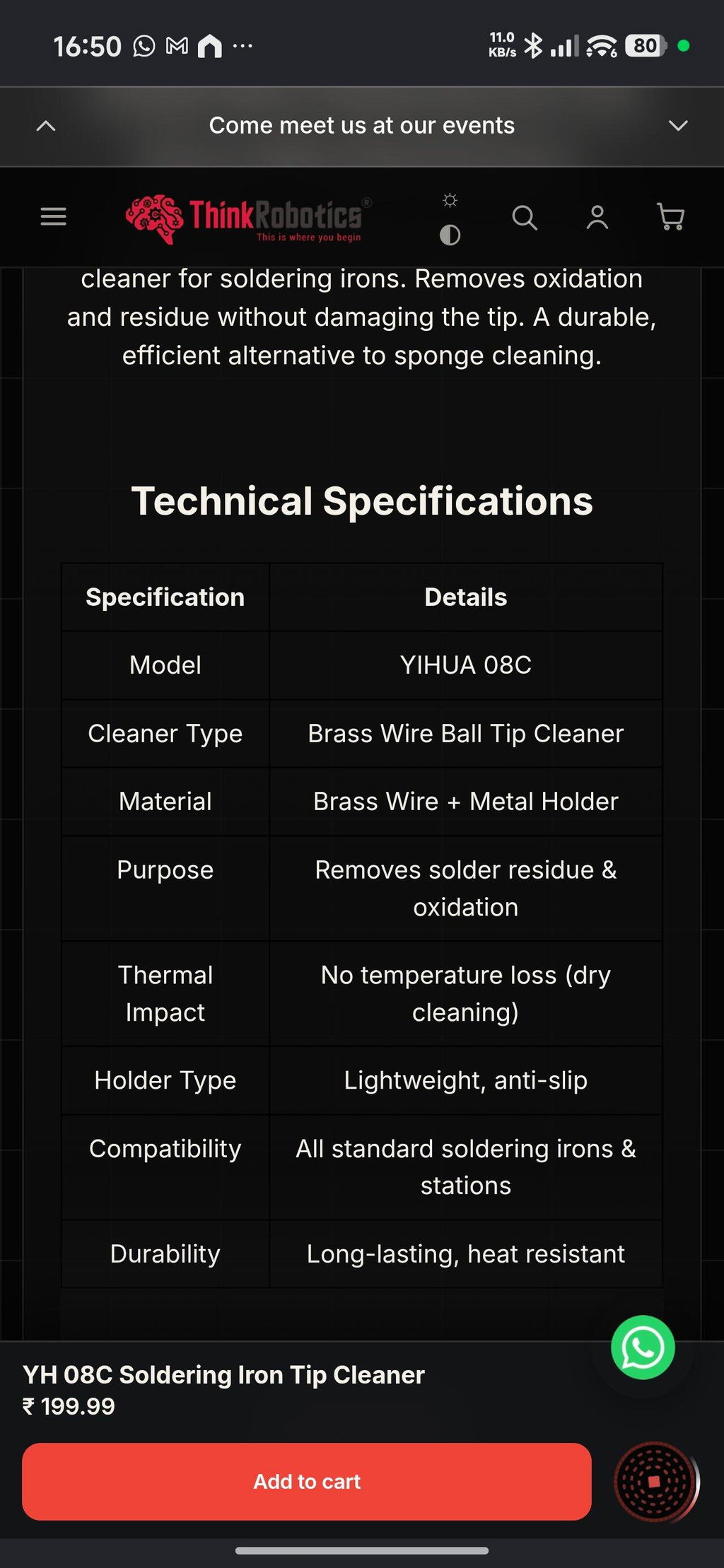
Given the fact that this was my first purchase and I made it thinking I was buying genuine Yihua products, this has been a setback. I received a lesser known OEM brand called MYTO and while both the products seem to be similar from appearance, my real contention is the quality and quantity of the brass wool. On top of that not informing the customer about the unavailability of the Yihua product and instead sending a product from a different brand is also antagonising. Henceforth, I might just have to think twice before ordering from ThinkRobotics.
TOF MINIF Range Sensor - UART TOF Time-of-Flight Laser Range Sensor
We are disappointed with our recent order experience. We clearly communicated our requirement for 433 MHz antennas on WhatsApp, but the issue remains unresolved. We have been following up for more than 10 days and are still waiting for a proper refund resolution.
As a regular B2B customer, we expected better support. This experience has affected our trust in ThinkRobotics, and we may have to consider other suppliers for future purchases. We request a fair and prompt refund.
Anodised Aluminium Cup Head Washers (Pack of 10)