Electrical Energy Calculator
Calculate electricity use from power and duration, or constant DC voltage and current. Compare energy use over different operating times in watt-hours, kilowatt-hours and joules.
Open tool
Interactive calculation is unavailable until JavaScript loads. The formulas, worked examples and references below remain available.
Calculate the resistance, voltage drop and power loss of a PCB trace from its width, length and copper thickness, and estimate its IPC-2221 temperature rise.
Enter the trace width and length with their units.
Enter the copper thickness as ounces, μm or mil, and the copper temperature.
Enter the current, and choose external or internal layer for the temperature rise.
Read the resistance, sheet resistance, voltage drop, power and the IPC-2221 temperature rise.
Copy result copies labeled values; Reset restores the starting fields.
A trace is a flat copper conductor, so its resistance is the copper's resistivity times the length divided by the cross-section, width times thickness. Annealed copper is 1/58 Ω mm2/m at 20 °C, and resistance rises 0.393 % per °C.
Board designers often count squares: a square of copper of any size has the same resistance, the sheet resistance ρ / t. For 1 oz (35 μm) copper at 20 °C that is about 0.49 mΩ per square, and a trace's resistance is that times its length divided by its width.
The power dissipated is I^2 × R. How hot that makes the trace depends on how it sheds heat. The IPC-2221 first-pass relation I = k × ΔT^0.44 × A^0.725, solved here for ΔT, gives the rise above ambient: k = 0.048 for outer layers and 0.024 for inner layers, so an inner trace runs about 4.8 times hotter by this estimate.
IPC-2152 (2009) replaced the old charts with measurements that include board thickness, planes and vias, and it often predicts cooler inner traces. Treat the rise as a first pass and check hot traces with IPC-2152 or a thermal simulation.
Limitations: DC resistance with IACS annealed copper and a uniform rectangular cross-section; real foil, plating on outer layers, etch undercut and solder change it by a few percent or more. The copper temperature is entered, not solved from the rise. The rise is an empirical fit to still-air charts for a single trace, valid up to 35 A, 400 mil, 10 to 100 °C and 0.5 to 3 oz, and the tool flags anything outside that range. It does not give the width needed for a current (the trace-width calculator does) and is not a fusing rating.
Resistivity: ρ = (1/58) × (1 + 0.00393 × (T - 20)) Ω mm2/m.
Resistance: R = ρ × L / (W × t), with L in m and W, t in mm.
Sheet resistance: R_sq = ρ / t; R = R_sq × L / W.
Drop and power: V = I × R; P = I^2 × R.
Temperature rise: ΔT = (I / (k × A^0.725))^(1/0.44), A in mil2, k = 0.048 external, 0.024 internal.
10 mil wide, 100 mm long, 1 oz, 20 °C, 1 A, external: 193.9 mΩ; 193.9 mV; 193.9 mW; rise 13.2 °C. 0.4926 mΩ per square × 393.7 squares; A = 13.78 mil2.
Same trace on an internal layer: rise 63.7 °C. Common mistake: using the outer-layer estimate inside the board; k halves and the rise grows 4.8 times.
1 mm wide, 50 mm long, 1 oz, 20 °C, 3 A, external: 24.63 mΩ; 73.89 mV; 221.7 mW; rise 16.7 °C. 50 squares of 0.4926 mΩ.
100 mil wide, 4 in long, 2 oz, 60 °C, 5 A, external: 11.4 mΩ; 57 mV; 285 mW; rise 3.67 °C, below the lowest chart curve. ρ at 60 °C = 0.019952 Ω mm2/m over 0.1778 mm2.
0.3 mm wide, 100 mm long, 1 oz, 85 °C, 1 A: 206.1 mΩ. Boundary of a hot board: the same trace at 20 °C is 164.2 mΩ.
NBS Handbook 100: Copper Wire Tables
OpenStax: Resistivity and resistance
Advanced Circuits: trace width calculator (IPC-2221 constants)
Available now
Calculate electricity use from power and duration, or constant DC voltage and current. Compare energy use over different operating times in watt-hours, kilowatt-hours and joules.
Open tool →Available now
Add up to 20 resistors in series using Ω, kΩ or MΩ for circuit analysis and electricity calculations, with a diagram and running total.
Open tool →Available now
Convert absolute temperatures between Celsius, Fahrenheit and kelvin.
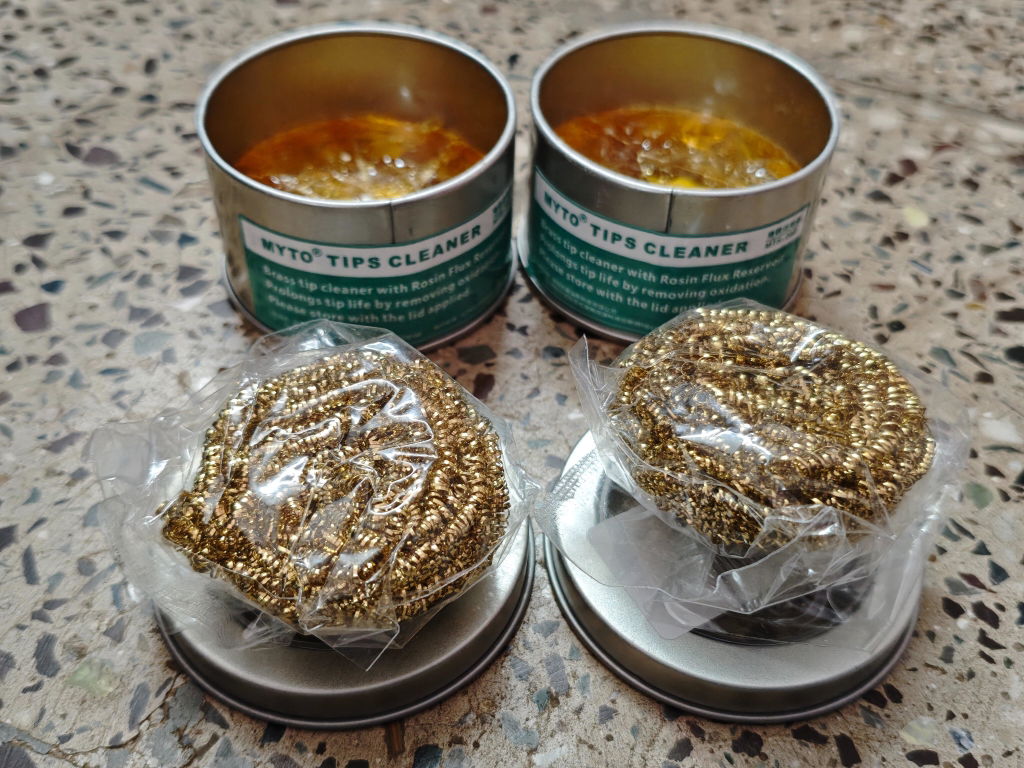
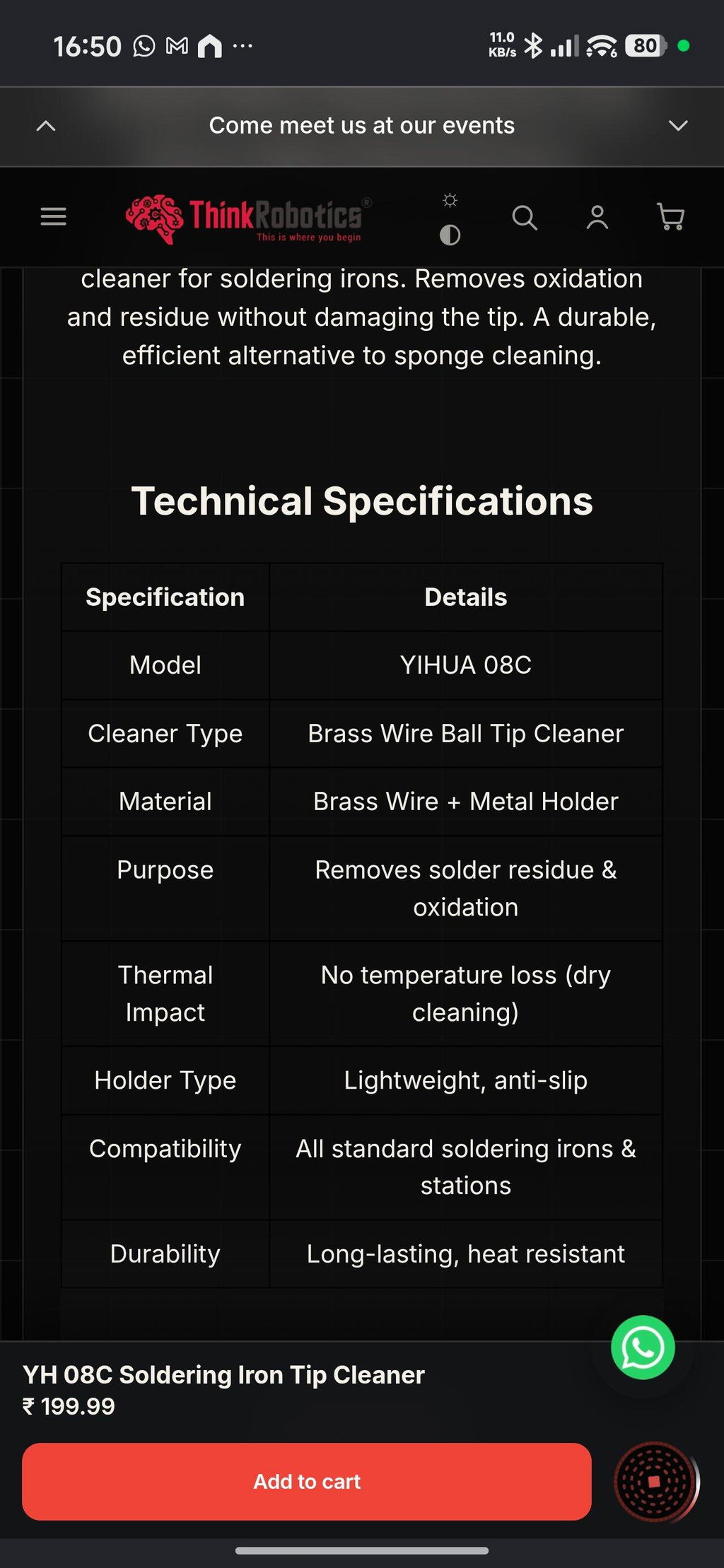
Open tool →Given the fact that this was my first purchase and I made it thinking I was buying genuine Yihua products, this has been a setback. I received a lesser known OEM brand called MYTO and while both the products seem to be similar from appearance, my real contention is the quality and quantity of the brass wool. On top of that not informing the customer about the unavailability of the Yihua product and instead sending a product from a different brand is also antagonising. Henceforth, I might just have to think twice before ordering from ThinkRobotics.
TOF MINIF Range Sensor - UART TOF Time-of-Flight Laser Range Sensor
We are disappointed with our recent order experience. We clearly communicated our requirement for 433 MHz antennas on WhatsApp, but the issue remains unresolved. We have been following up for more than 10 days and are still waiting for a proper refund resolution.
As a regular B2B customer, we expected better support. This experience has affected our trust in ThinkRobotics, and we may have to consider other suppliers for future purchases. We request a fair and prompt refund.
Anodised Aluminium Cup Head Washers (Pack of 10)