Electrical Energy Calculator
Calculate electricity use from power and duration, or constant DC voltage and current. Compare energy use over different operating times in watt-hours, kilowatt-hours and joules.
Open tool
Interactive calculation is unavailable until JavaScript loads. The formulas, worked examples and references below remain available.
Convert gyroscope and accelerometer raw counts, noise density, random walk and bias instability between common units, and find RMS noise over a bandwidth.
Choose Gyroscope or Accelerometer.
Choose a task: raw reading, noise density and random walk, or bias instability.
Enter the value from the datasheet or register with its unit; for raw readings, enter the sensitivity and word length.
For noise, enter the filter bandwidth and type to see the RMS noise, and an integration time to see the random-walk spread.
Read the result and the table of equivalent values. Copy result copies labeled values; Reset restores the starting fields.
IMU datasheets quote gyroscopes in °/s, °/h, mdps or rad/s and accelerometers in g, mg, μg or m/s2. One g is the standard acceleration of gravity, 9.80665 m/s2, exactly. Raw register readings are counts: divide by the sensitivity in LSB per unit to get the physical value; the full-scale range is the largest count divided by the sensitivity.
White sensor noise is given as a density per square root of hertz. The RMS noise you see is the density times the square root of the noise bandwidth. A first-order filter's noise bandwidth is 1.57 times its -3 dB bandwidth and a second-order Butterworth's is 1.11 times.
Integrating white rate noise makes the angle wander like a random walk whose spread grows with the square root of time. Angle random walk in °/√h is the noise density in °/s/√Hz times 60, because one hour is 3600 s and the square root of 3600 is 60; multiplying by 3600 instead is a common mistake. Accelerometers have velocity random walk in m/s/√h in the same way. Bias instability is the lowest point of the Allan deviation plot: the slow offset wander that averaging cannot remove.
Limitations: vendors convert density to random walk with the factor 60, treating the datasheet density as the Allan-variance coefficient; if a density is one-sided in the IEEE sense, the coefficient is smaller by the square root of 2, and the tool shows both. The RMS and random-walk results hold for white noise only. Temperature drift, scale-factor and cross-axis errors, quantisation and the real shape of an Allan curve are not modelled, and the bias drift line assumes the bias stays constant.
Raw counts: value = counts / S (S in LSB per unit); full scale = (2^(n-1) - 1) / S.
Gravity and angle: 1 g = 9.80665 m/s2; 1 rad = 180/π degrees; 1 h = 3600 s.
RMS noise: RMS = density × sqrt(ENBW); ENBW = 1.57 × f (first order), 1.11 × f (second-order Butterworth).
Angle random walk: ARW [°/√h] = 60 × density [°/s/√Hz] = density [°/h/√Hz] / 60.
Spread over time: σ = ARW × sqrt(t / 3600 s), in degrees for t in seconds.
Constant bias drift: angle = bias [°/s] × t; velocity = bias [g] × 9.80665 × t.
Gyroscope 131 LSB/(°/s), raw 1000: 7.63359 °/s (0.133231 rad/s); full scale -250.137 to 250.13 °/s. MPU-6050 at its ±250 °/s setting.
Accelerometer 16,384 LSB/g, raw 8192: 0.5 g = 4.90333 m/s2. 8192 / 16384.
Gyroscope 0.005 °/s/√Hz over a 100 Hz noise bandwidth: 0.05 °/s RMS. Matches the MPU-6050's total RMS noise at its 100 Hz filter.
Same density as angle random walk: 0.3 °/√h; spread 0.0387298 ° after 60 s. Common mistake: × 3600 gives 18, which is °/h/√Hz, not °/√h.
Accelerometer 400 μg/√Hz: VRW 0.23536 m/s/√h. 400e-6 × 9.80665 × 60.
Bias instability 10 °/h: 0.00277778 °/s = 2.77778 mdps; 0.166667 ° in 60 s if constant. 10 / 3600.
Accelerometer 2048 LSB/g, 16-bit raw -32768: -16 g (-156.906 m/s2). Boundary: the most negative 16-bit count is the end of the ±16 g range.
NIST CODATA: standard acceleration of gravity
VectorNav: IMU specifications explained
Advanced Navigation: Allan variance of Orientus, Spatial and Certus
NXP AN5087: Allan variance noise analysis for gyroscopes
TI SLVA043B: Noise analysis in operational amplifier circuits
Available now
Calculate electricity use from power and duration, or constant DC voltage and current. Compare energy use over different operating times in watt-hours, kilowatt-hours and joules.
Open tool →Available now
Add up to 20 resistors in series using Ω, kΩ or MΩ for circuit analysis and electricity calculations, with a diagram and running total.
Open tool →Available now
Convert absolute temperatures between Celsius, Fahrenheit and kelvin.
Open tool →Nice audio board working as expected.
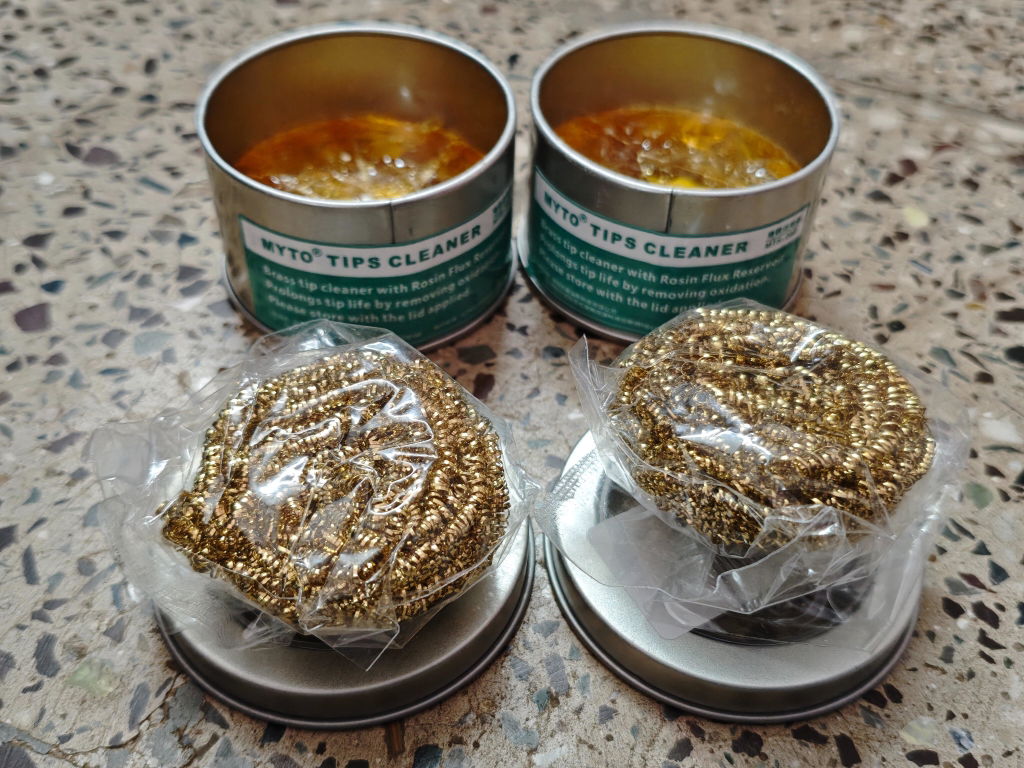
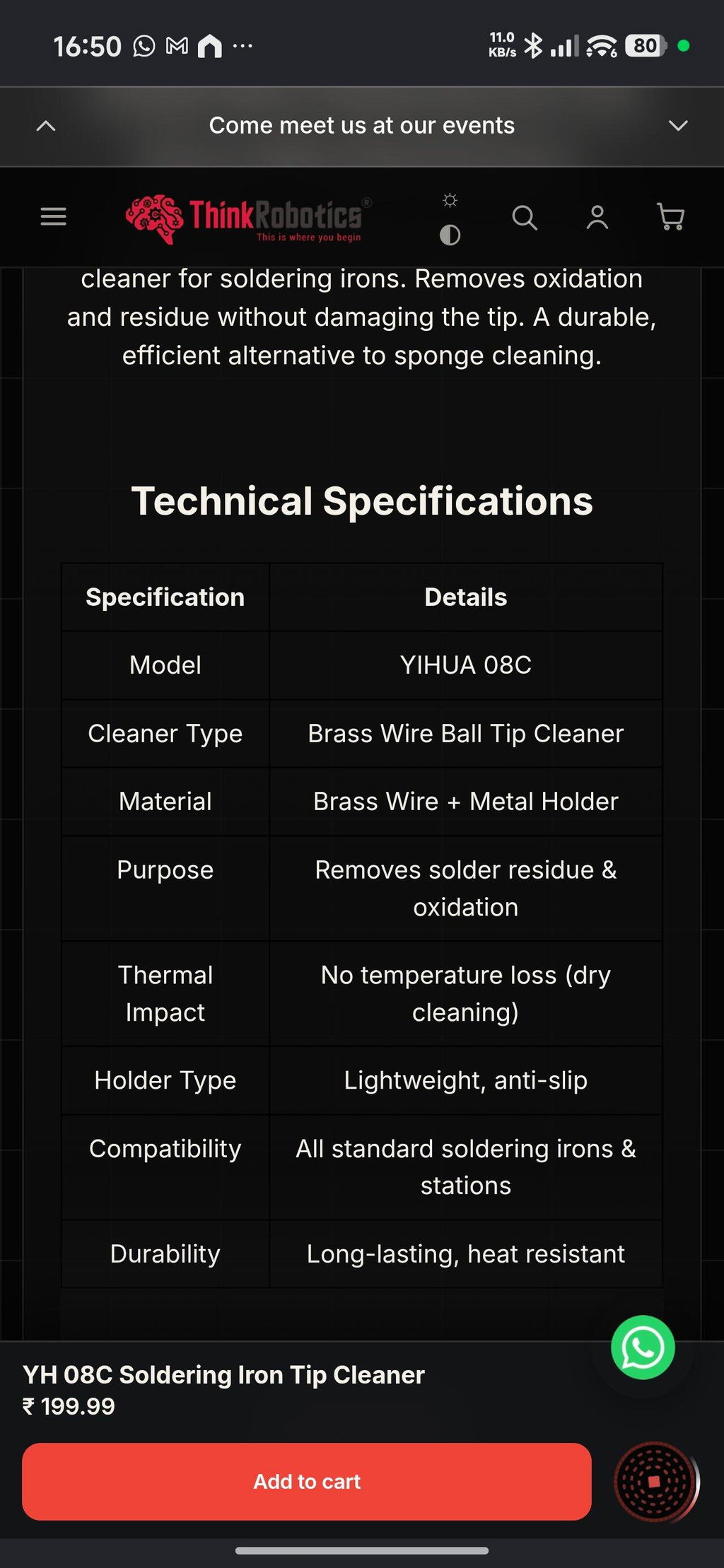
Given the fact that this was my first purchase and I made it thinking I was buying genuine Yihua products, this has been a setback. I received a lesser known OEM brand called MYTO and while both the products seem to be similar from appearance, my real contention is the quality and quantity of the brass wool. On top of that not informing the customer about the unavailability of the Yihua product and instead sending a product from a different brand is also antagonising. Henceforth, I might just have to think twice before ordering from ThinkRobotics.
TOF MINIF Range Sensor - UART TOF Time-of-Flight Laser Range Sensor
We are disappointed with our recent order experience. We clearly communicated our requirement for 433 MHz antennas on WhatsApp, but the issue remains unresolved. We have been following up for more than 10 days and are still waiting for a proper refund resolution.
As a regular B2B customer, we expected better support. This experience has affected our trust in ThinkRobotics, and we may have to consider other suppliers for future purchases. We request a fair and prompt refund.
Anodised Aluminium Cup Head Washers (Pack of 10)