Electrical Energy Calculator
Calculate electricity use from power and duration, or constant DC voltage and current. Compare energy use over different operating times in watt-hours, kilowatt-hours and joules.
Open tool
Interactive calculation is unavailable until JavaScript loads. The formulas, worked examples and references below remain available.
Find the sample rate an oscilloscope runs at for a memory depth and timebase, or the memory or timebase for a sample rate, with rise time and sampling margin from its bandwidth.
Choose Sample rate, Memory or Timebase.
Enter the time per division and the number of horizontal divisions, and the memory depth or sample rate the task asks for.
Optionally enter the scope's maximum sample rate, its bandwidth and response type, and the rise time of the signal edge.
Read the sample rate, memory or time per division, then the capture window, sample interval and sampling margin.
Copy result copies labelled values; Reset restores the starting fields.
A digital oscilloscope fills its memory across the screen. The window is the time per division times the number of horizontal divisions, so the sample rate is the memory depth divided by that window, up to the scope's maximum rate. At slow timebases a scope with shallow memory must sample more slowly.
Bandwidth sets how fast an edge the scope can show. For the Gaussian-like response of most scopes up to 1 GHz, the 10–90 % rise time is about 0.35 divided by the bandwidth; flatter responses above 1 GHz use about 0.4 to 0.5. A signal edge and the scope's own rise time combine as the square root of the sum of their squares, which is why a scope should be several times faster than the edge it measures.
Sampling must be faster than twice the highest frequency present (Nyquist). A Gaussian response still passes energy above its bandwidth, so Keysight recommends at least 4 times the bandwidth, and 2.5 times for a sharp flat response.
Limitations: real scopes offer fixed sample rates and record lengths, may share memory or halve the rate when more channels are on, and may use decimation, interpolation or segmented memory. The 0.35 and 0.45 constants and the 4 × and 2.5 × minimums are typical values for a response shape, not the specification of any scope, and root-sum-of-squares rise time does not apply to flat-response scopes.
Capture window: T = t_div × N_div. t_div is the time per division, N_div the number of horizontal divisions.
Sample rate: f_s = M / T, up to the maximum sample rate. M is the memory depth in points.
Memory: M = f_s × T, rounded up to a whole point.
Timebase: t_div = M / (f_s × N_div).
Rise time: t_r = k / BW, k = 0.35 for a Gaussian response, about 0.45 for a maximally flat one.
Sample-rate minimum: f_s ≥ 4 × BW (Gaussian) or 2.5 × BW (flat); Nyquist requires f_s > 2 × f_max.
Displayed rise time: t_shown = sqrt(t_signal² + t_scope²), Gaussian response only.
1 Mpts at 100 μs/div, 10 divisions: 1 GS/s; 1 ns between samples. Window 10 × 100 μs = 1 ms; 1,000,000 / 0.001 s.
4 Mpts at 160 μs/div, 10 divisions: 2.5 GS/s. Keysight's example: 4,000,000 / 1.6 ms.
24 Mpts at 1 ms/div, 12 divisions, maximum 1 GS/s: 1 GS/s, using 12,000,000 points. 24,000,000 / 12 ms = 2 GS/s is above the maximum.
2 GS/s at 1 ms/div, 10 divisions: 20,000,000 points (20 Mpts). 2e9 × 0.01 s.
100 MHz Gaussian scope, 5 ns edge, 1 GS/s: Scope 3.5 ns; edge shown as 6.10 ns (+22.1 %); 10 × bandwidth. 0.35 / 100 MHz; sqrt(5² + 3.5²).
1 Mpts at 100 μs/div, treating 100 μs as the window: 10 GS/s instead of 1 GS/s. Common mistake: multiply by the number of divisions first.
2.5 GS/s at 1.1 ns/div, 10 divisions: 28 points. Boundary: 27.5 points rounds up.
Keysight 5989-5733EN: Evaluating oscilloscope bandwidths for your application
Keysight 5991-1024EN: Oscilloscope memory architectures
Available now
Calculate electricity use from power and duration, or constant DC voltage and current. Compare energy use over different operating times in watt-hours, kilowatt-hours and joules.
Open tool →Available now
Add up to 20 resistors in series using Ω, kΩ or MΩ for circuit analysis and electricity calculations, with a diagram and running total.
Open tool →Available now
Convert absolute temperatures between Celsius, Fahrenheit and kelvin.
Open tool →Nice audio board working as expected.
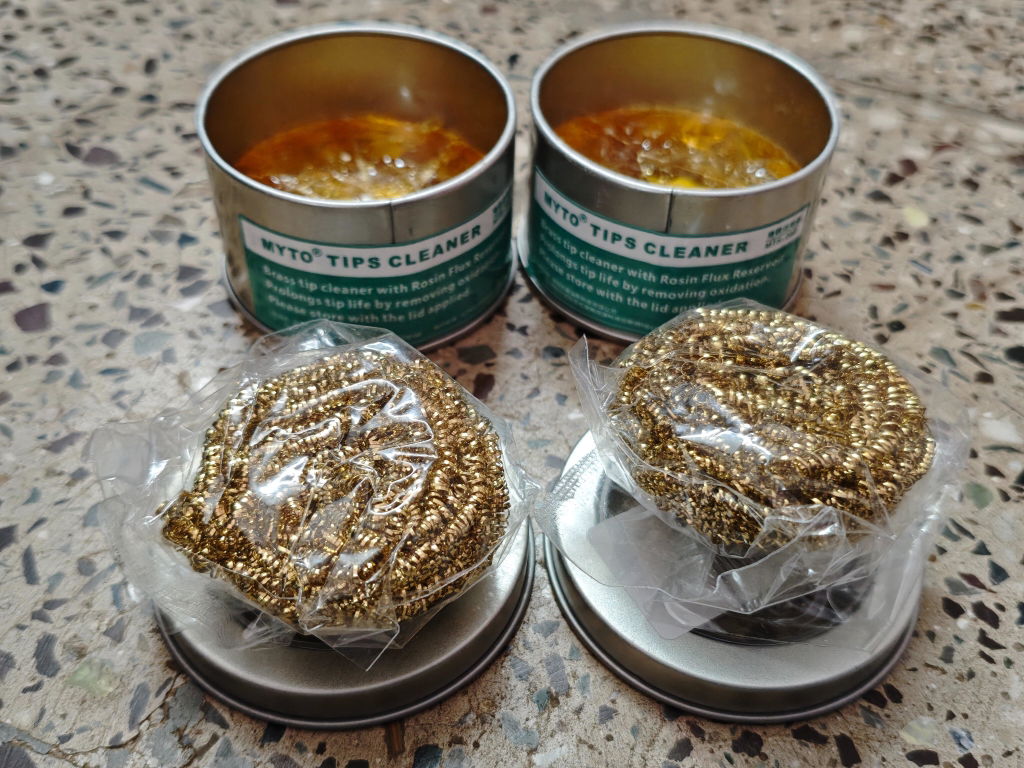
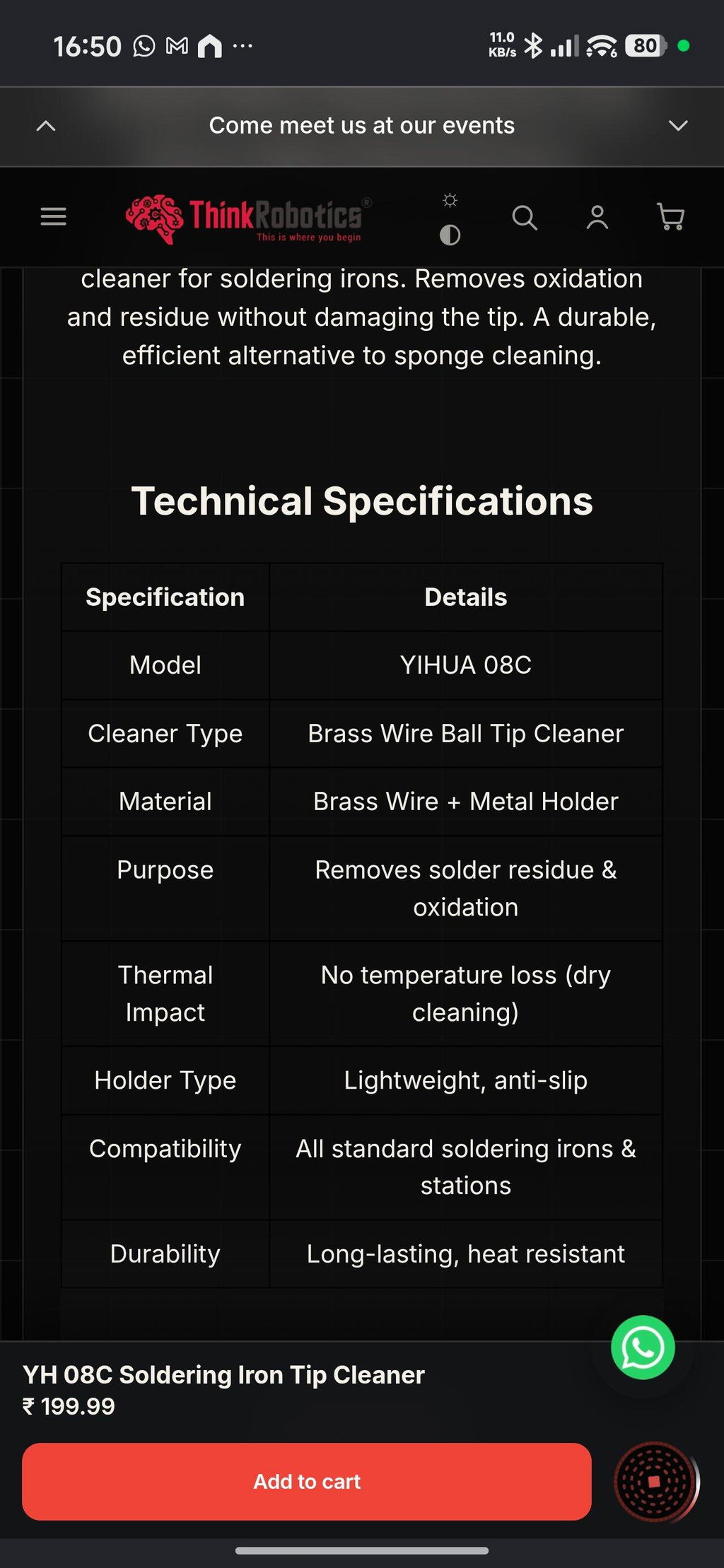
Given the fact that this was my first purchase and I made it thinking I was buying genuine Yihua products, this has been a setback. I received a lesser known OEM brand called MYTO and while both the products seem to be similar from appearance, my real contention is the quality and quantity of the brass wool. On top of that not informing the customer about the unavailability of the Yihua product and instead sending a product from a different brand is also antagonising. Henceforth, I might just have to think twice before ordering from ThinkRobotics.
TOF MINIF Range Sensor - UART TOF Time-of-Flight Laser Range Sensor
We are disappointed with our recent order experience. We clearly communicated our requirement for 433 MHz antennas on WhatsApp, but the issue remains unresolved. We have been following up for more than 10 days and are still waiting for a proper refund resolution.
As a regular B2B customer, we expected better support. This experience has affected our trust in ThinkRobotics, and we may have to consider other suppliers for future purchases. We request a fair and prompt refund.
Anodised Aluminium Cup Head Washers (Pack of 10)