Electrical Energy Calculator
Calculate electricity use from power and duration, or constant DC voltage and current. Compare energy use over different operating times in watt-hours, kilowatt-hours and joules.
Open tool
Interactive calculation is unavailable until JavaScript loads. The formulas, worked examples and references below remain available.
Calculate SPI transfer time and throughput from clock rate, frame size, frame count and gaps, or the clock needed for a time budget.
Choose Transfer time or Clock for a time budget.
Enter the SCK frequency, or the time budget, with its unit. The slider sets the SCK frequency in steps.
Enter bits per frame (8 for bytes) and the number of frames.
Choose standard, dual or quad data lanes.
Optionally enter the gap between frames and the chip-select setup plus hold time, in microseconds.
Read the result, throughput and time breakdown. Copy result copies labeled values; Reset restores the starting example.
SPI is a synchronous bus: the controller drives SCK and each SCK cycle moves one bit on each data line. A frame of b bits on one line therefore takes b clock periods, whatever the clock polarity and phase mode.
Real transfers add idle time. Many controllers insert a programmable delay between frames, and chip select must be asserted before the first edge and held after the last. Those times do not scale with SCK, so above some clock frequency they dominate the total.
Dual and quad SPI move 2 or 4 bits per clock on separate lines. Memory devices often send the command and address on one line and only the data on all lanes, so a quad transfer is slower than this ideal.
Limitations: the tool assumes a constant SCK, no clock stretching, and the same lane count for every bit. It does not model DMA set-up, interrupt latency, software gaps you have not measured, or the maximum SCK of your device and wiring. The minimum clock is a lower bound; choose an available clock at or above it.
Data time: t_data = F × b / (w × f). F frames of b bits on w lanes at SCK frequency f.
Transfer time: T = t_data + (F - 1) × t_gap + t_cs.
Throughput: R = F × b / T bits per second; divide by 8 for bytes per second.
Minimum clock: f_min = F × b / (w × (T_max - (F - 1) × t_gap - t_cs)). No solution when the bracket is 0 or less.
SCK period: t_sck = 1 / f.
10 MHz, 8-bit frames, 256 frames, standard SPI: 204.8 μs, 1.25 MB/s. 256 × 8 / 10e6 s.
8 MHz, 16-bit frames, 100 frames, 1 μs gaps, 0.5 μs chip-select: 299.5 μs, 5.342237062 Mbit/s. 200 μs of data, 99 μs of gaps and 0.5 μs of chip-select time.
50 MHz quad SPI, 4096 bytes: 163.84 μs. 32768 bits on 4 lanes take 8192 clocks.
1024 bytes in 1 ms, standard SPI: 8.192 MHz minimum SCK. 8192 bits / 1 ms.
100 16-bit frames in 50 μs with 1 μs gaps: No clock meets the budget. Common mistake: 99 μs of gaps already exceed the 50 μs budget.
Available now
Calculate electricity use from power and duration, or constant DC voltage and current. Compare energy use over different operating times in watt-hours, kilowatt-hours and joules.
Open tool →Available now
Add up to 20 resistors in series using Ω, kΩ or MΩ for circuit analysis and electricity calculations, with a diagram and running total.
Open tool →Available now
Convert absolute temperatures between Celsius, Fahrenheit and kelvin.
Open tool →Nice audio board working as expected.
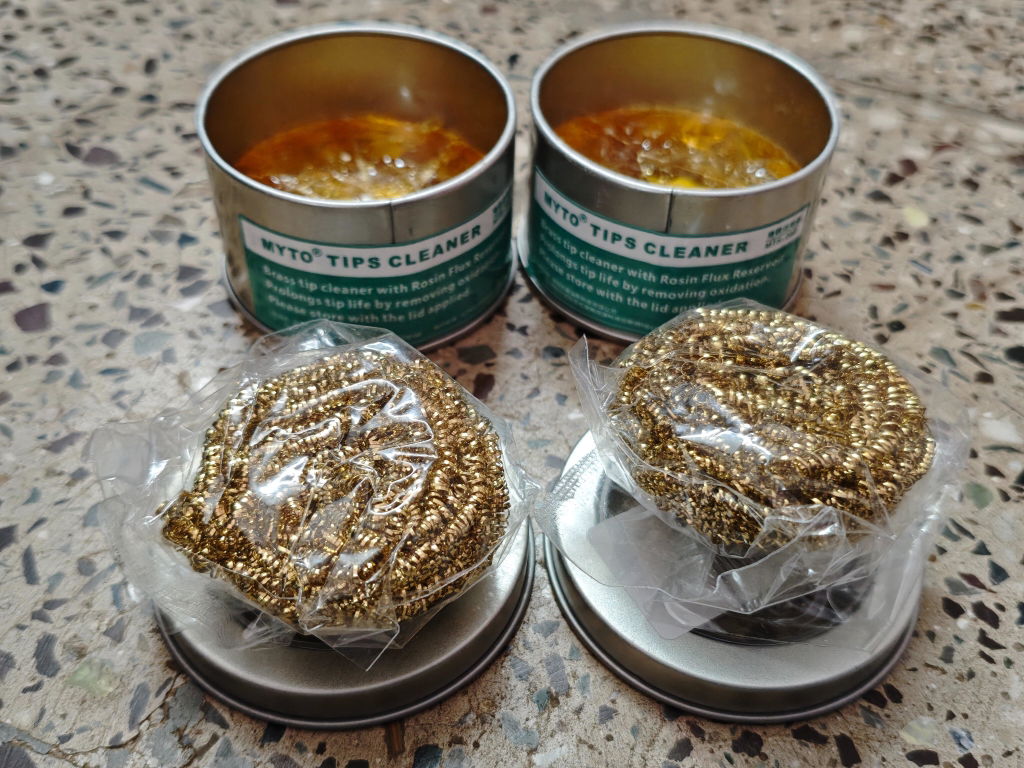
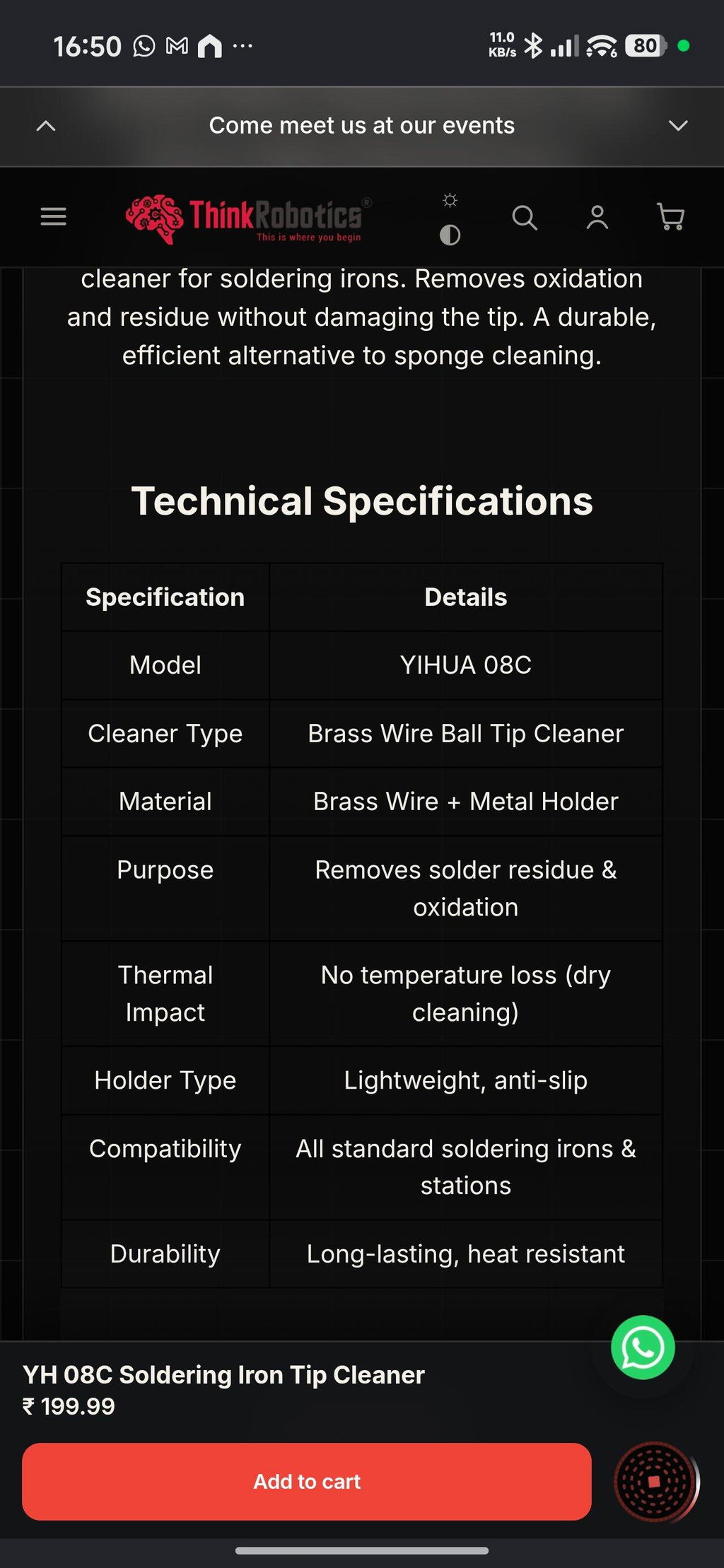
Given the fact that this was my first purchase and I made it thinking I was buying genuine Yihua products, this has been a setback. I received a lesser known OEM brand called MYTO and while both the products seem to be similar from appearance, my real contention is the quality and quantity of the brass wool. On top of that not informing the customer about the unavailability of the Yihua product and instead sending a product from a different brand is also antagonising. Henceforth, I might just have to think twice before ordering from ThinkRobotics.
TOF MINIF Range Sensor - UART TOF Time-of-Flight Laser Range Sensor
We are disappointed with our recent order experience. We clearly communicated our requirement for 433 MHz antennas on WhatsApp, but the issue remains unresolved. We have been following up for more than 10 days and are still waiting for a proper refund resolution.
As a regular B2B customer, we expected better support. This experience has affected our trust in ThinkRobotics, and we may have to consider other suppliers for future purchases. We request a fair and prompt refund.
Anodised Aluminium Cup Head Washers (Pack of 10)