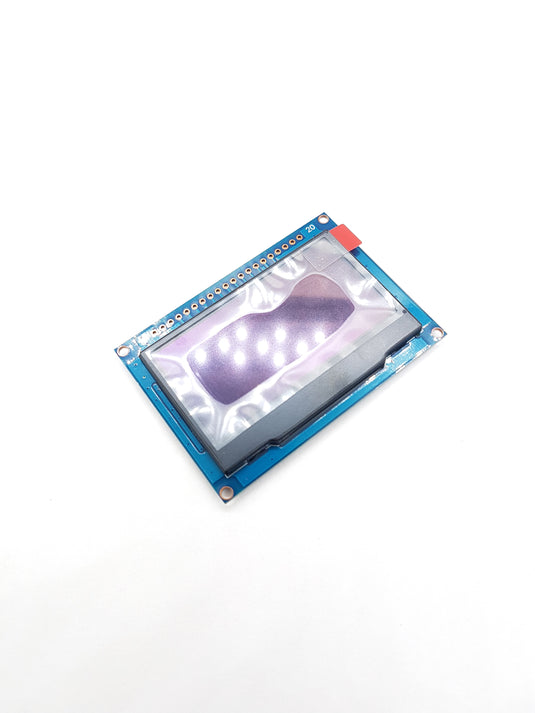
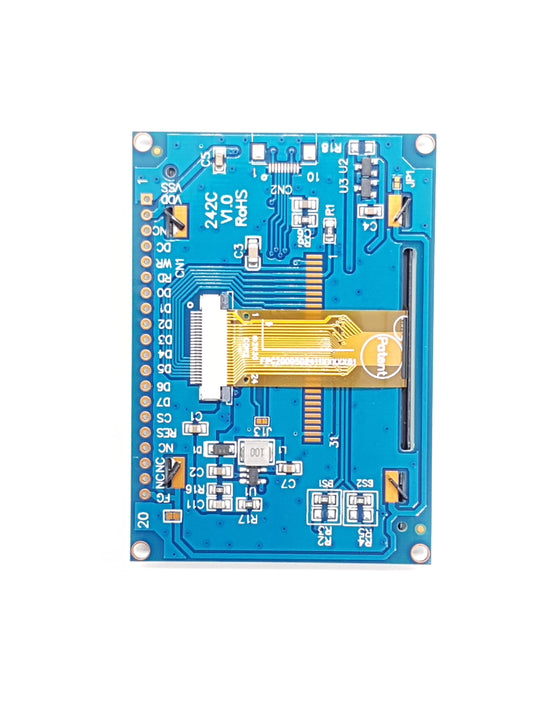
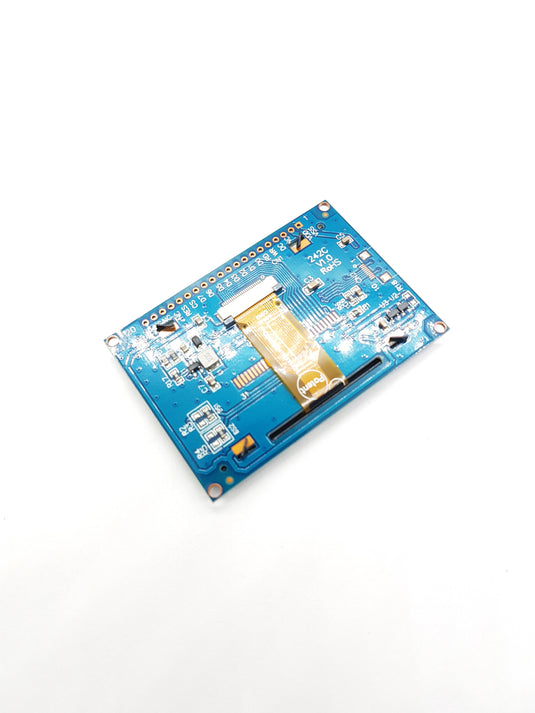
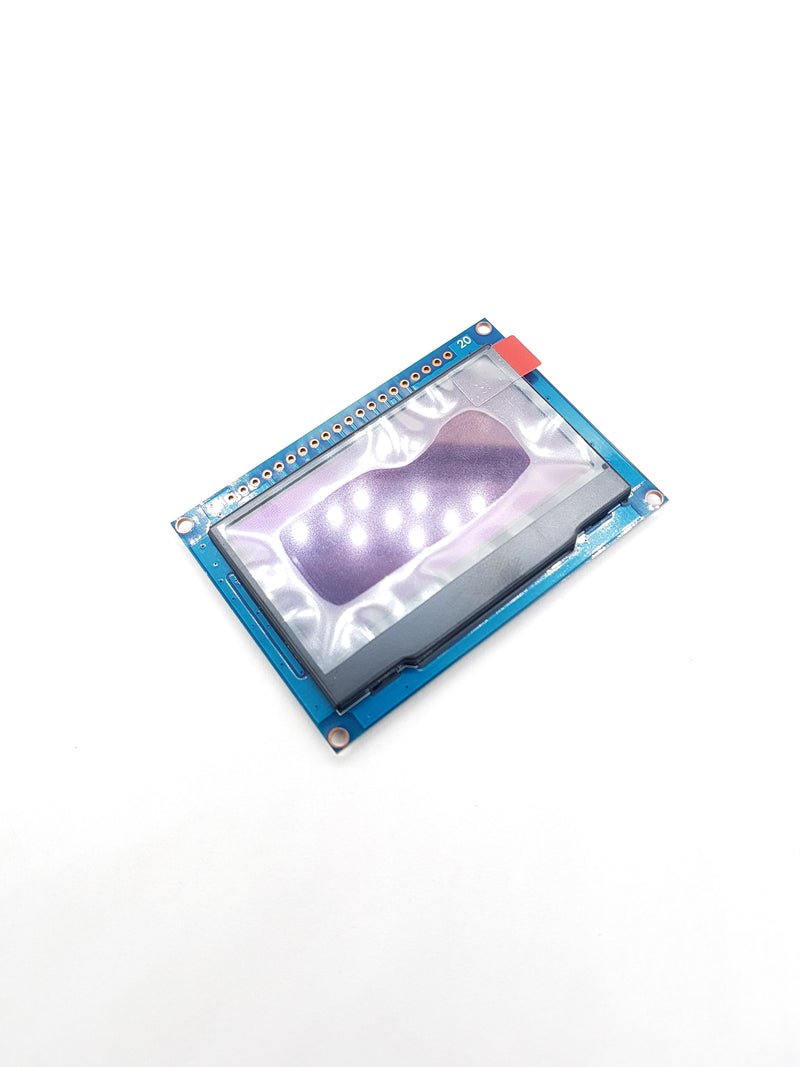
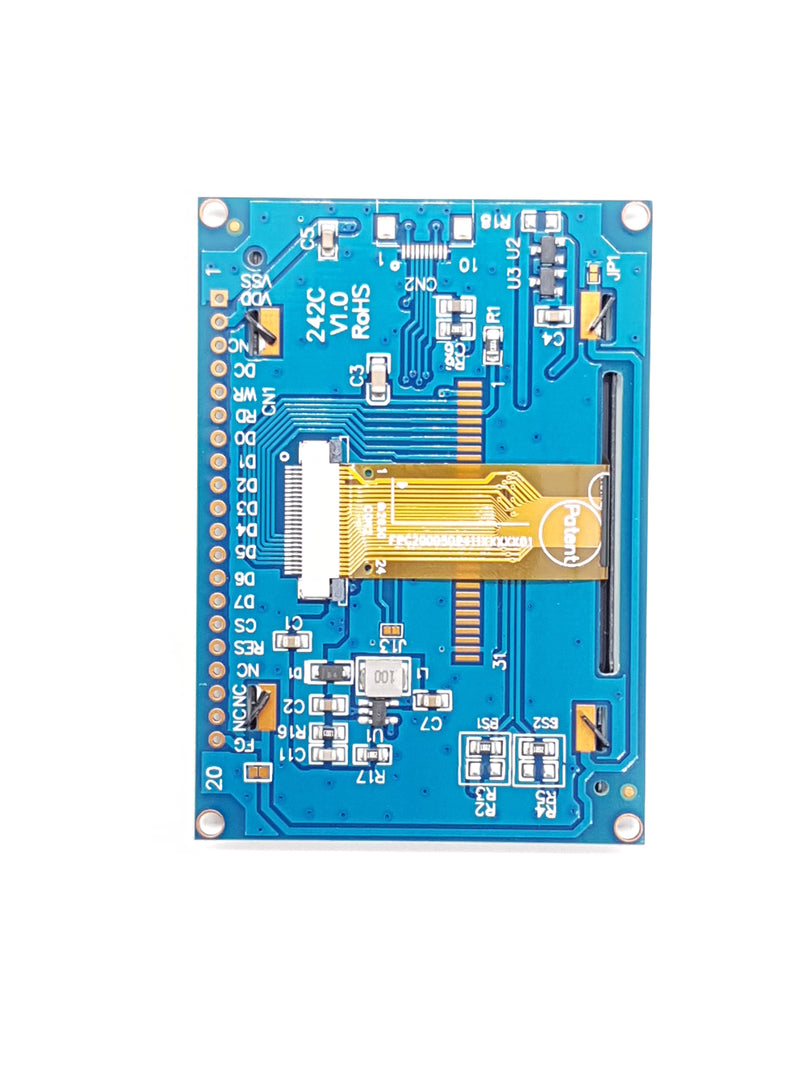
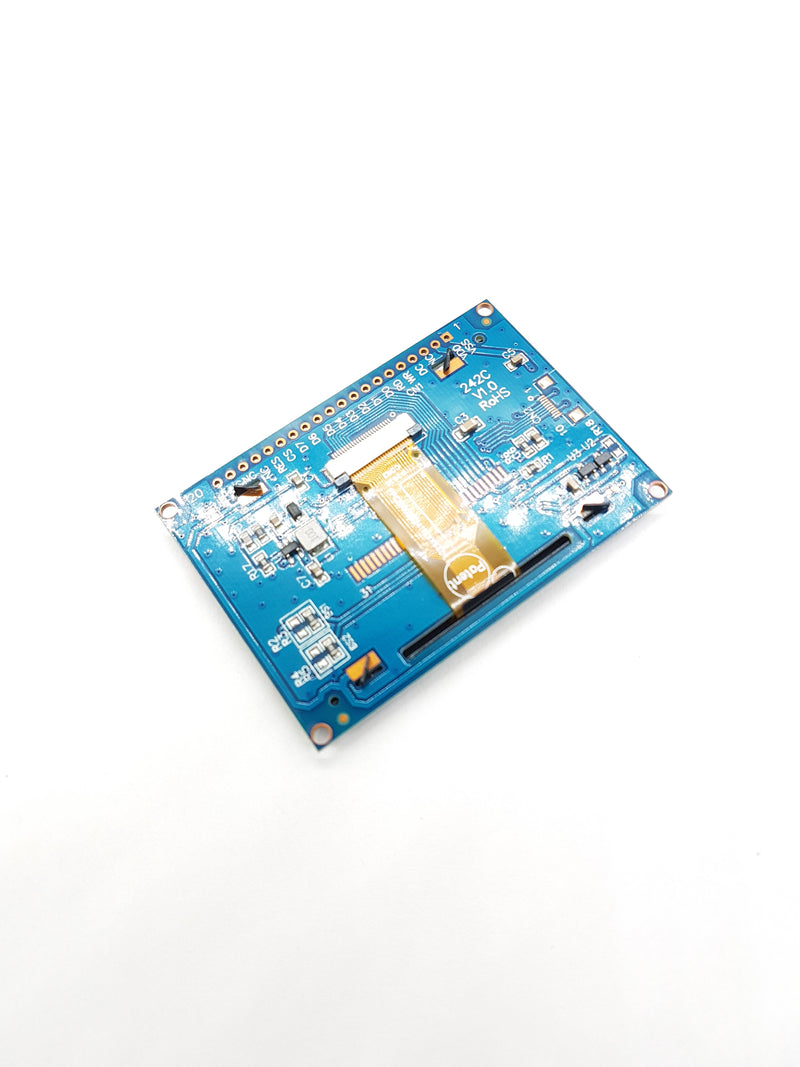
The display is 2.42" diagonal, and very readable due to the high contrast of an OLED display. This display is made of 128x64 individual white OLED pixels, each one turned on or off by the controller chip. Because the display makes its own light, no backlight is required. This reduces the power required to run the OLED and is why the display has such high contrast; we really like this graphic display for its crispness!
The driver chip, SSD1305 can communicate in three ways: 8-bit, I2C or SPI. Personally we think SPI is the way to go, only 4 or 5 wires are required and its very fast. The OLED itself requires a 3.3V power supply and 3.3V logic levels for communication. We include a breadboard-friendly level shifter that can convert 3V or 5V down to 3V, so it can be used with 5V-logic devices like Arduino.
The power requirements depend a little on how much of the display is lit but on average the display uses about 50mA from the 3.3V supply. Built into the OLED driver is a simple switch-cap charge pump that turns 3.3V into a high voltage drive for the OLEDs.
Each order comes with one assembled OLED module with a nice bezel and 4 mounting holes. The display is 3V logic & power so we include a HC4050 level shifter. We also toss in a 220uF capacitor, as we noticed an Arduino may need a little more capacitance on the 3.3V power supply for this big display! This display does not come with header attached but we do toss in a stick of header you can solder on. Also, the display may come in SPI mode. You can change modes from 8-bit to SPI or I2C with a little soldering, check out the tutorial for how to do so. Please Note: Metro not included! A microcontroller such an Arduino is required to use.
Getting started is easy! We have a detailed tutorial and example code in the form of an Arduino library for text and graphics. You'll need a microcontroller with more than 512 bytes of RAM since the display must be buffered. The library can print text, bitmaps, pixels, rectangles, circles and lines. It uses 512 bytes of RAM since it needs to buffer the entire display but its very fast! The code is simple to adapt to any other microcontroller.
Note: Cable and code on back of board may vary but displays will work the same.
Please note that OLED displays are made of hundreds of...OLEDs! That means each pixel is a little organic LED, and if its kept on for over 1000 hours it'll start to dim. If you want to keep the display uniformly bright, please turn off the display (set the pixels off) when it isn't needed to keep them from dimming.
Technical Details
Screen Dimensions: 1.14" x 2.2" x .26" / 29mm x 56mm x 6.8mm
Screen Weight: 22g
Driving voltage: 3.3V
Interfaces: 8 parallel port, 4-wire SPI, I2C
Datasheet for SSD1305the passive OLED driver chip in the module this is the chip in the module that converts SPI/8-bit commands to OLED control signals
Use left/right arrows to navigate the slideshow or swipe left/right if using a mobile device
Choosing a selection results in a full page refresh.
Press the space key then arrow keys to make a selection.
Shopping Cart
Cannot place order, conditions not met:
OK
{"id":6631592394838,"title":"2.42\" Inch 128X64 OLED Display","handle":"2-42-inch-128x64-oled-display","description":"\u003ch2 style=\"text-align: center;\"\u003e2.42\" Inch 128X64 OLED Display\u003c\/h2\u003e\n\u003cp style=\"text-align: left;\"\u003eThe display is 2.42\" diagonal, and very readable due to the high contrast of an OLED display. This display is made of 128x64 individual white OLED pixels, each one turned on or off by the controller chip. Because the display makes its own light, no backlight is required. This reduces the power required to run the OLED and is why the display has such high contrast; we really like this graphic display for its crispness!\u003c\/p\u003e\n\u003cp style=\"text-align: left;\"\u003eThe driver chip, SSD1305 can communicate in three ways: 8-bit, I2C or SPI. Personally we think SPI is the way to go, only 4 or 5 wires are required and its very fast. The OLED itself requires a 3.3V power supply and 3.3V logic levels for communication. We include a breadboard-friendly level shifter that can convert 3V or 5V down to 3V, so it can be used with 5V-logic devices like Arduino.\u003c\/p\u003e\n\u003cp style=\"text-align: left;\"\u003eThe power requirements depend a little on how much of the display is lit but on average the display uses about 50mA from the 3.3V supply. Built into the OLED driver is a simple switch-cap charge pump that turns 3.3V into a high voltage drive for the OLEDs.\u003c\/p\u003e\n\u003cp style=\"text-align: left;\"\u003eEach order comes with one assembled OLED module with a nice bezel and 4 mounting holes. The display is 3V logic \u0026amp; power so we include a HC4050 level shifter. We also toss in a 220uF capacitor, as we noticed an Arduino may need a little more capacitance on the 3.3V power supply for this big display! This display does not come with header attached but we do toss in a stick of header you can solder on. Also, the display may come in SPI mode. You can change modes from 8-bit to SPI or I2C with a little soldering, check out the tutorial for how to do so. Please Note: Metro not included! A microcontroller such an Arduino is required to use.\u003c\/p\u003e\n\u003cp style=\"text-align: left;\"\u003eGetting started is easy! We have a detailed tutorial and example code in the form of an Arduino library for text and graphics. You'll need a microcontroller with more than 512 bytes of RAM since the display must be buffered. The library can print text, bitmaps, pixels, rectangles, circles and lines. It uses 512 bytes of RAM since it needs to buffer the entire display but its very fast! The code is simple to adapt to any other microcontroller.\u003c\/p\u003e\n\u003cp style=\"text-align: left;\"\u003eNote: Cable and code on back of board may vary but displays will work the same.\u003c\/p\u003e\n\u003cp style=\"text-align: left;\"\u003ePlease note that OLED displays are made of hundreds of...OLEDs! That means each pixel is a little organic LED, and if its kept on for over 1000 hours it'll start to dim. If you want to keep the display uniformly bright, please turn off the display (set the pixels off) when it isn't needed to keep them from dimming.\u003c\/p\u003e\n\u003cp style=\"text-align: center;\"\u003e \u003c\/p\u003e\n\u003ch2 style=\"text-align: left;\"\u003eTechnical Details\u003c\/h2\u003e\n\u003cul\u003e\n\u003cli style=\"text-align: left;\"\u003e\n\u003cstrong\u003eScreen Dimensions: \u003c\/strong\u003e1.14\" x 2.2\" x .26\" \/ 29mm x 56mm x 6.8mm\u003cbr\u003e\u003cstrong\u003e\u003c\/strong\u003e\n\u003c\/li\u003e\n\u003cli style=\"text-align: left;\"\u003e\n\u003cstrong\u003eScreen Weight: \u003c\/strong\u003e22g\u003cbr\u003e\u003cstrong\u003e\u003c\/strong\u003e\n\u003c\/li\u003e\n\u003cli style=\"text-align: left;\"\u003e\n\u003cstrong\u003eDriving voltage: \u003c\/strong\u003e3.3V\u003cbr\u003e\u003cstrong\u003e\u003c\/strong\u003e\n\u003c\/li\u003e\n\u003cli style=\"text-align: left;\"\u003e\n\u003cstrong\u003eInterfaces: \u003c\/strong\u003e8 parallel port, 4-wire SPI, I2C\u003cbr\u003e\u003cem\u003e\u003cspan style=\"color: rgb(43, 0, 255);\"\u003e\u003ca href=\"https:\/\/cdn.shopify.com\/s\/files\/1\/0014\/4313\/5560\/files\/Microsoft_Word_-_Convert_WMF_to_PDF.doc.pdf?v=1763620538\" rel=\"noopener\" target=\"_blank\"\u003e\u003cstrong\u003e\u003c\/strong\u003e\u003c\/a\u003e\u003c\/span\u003e\u003c\/em\u003e\n\u003c\/li\u003e\n\u003cli style=\"text-align: left;\"\u003e\n\u003cem\u003e\u003cstrong\u003e\u003ca rel=\"noopener\" href=\"https:\/\/cdn.shopify.com\/s\/files\/1\/0014\/4313\/5560\/files\/2719_DATA.pdf?v=1763620519\" target=\"_blank\"\u003e\u003cspan style=\"text-decoration: underline;\"\u003eDatasheet for SSD1305\u003c\/span\u003e\u003c\/a\u003e\u003ca rel=\"noopener\" href=\"https:\/\/cdn.shopify.com\/s\/files\/1\/0014\/4313\/5560\/files\/2719_DATA.pdf?v=1763620519\" target=\"_blank\"\u003e\u003cspan style=\"text-decoration: underline;\"\u003e\u003c\/span\u003e\u003c\/a\u003e\u003c\/strong\u003e\u003cspan style=\"color: rgb(43, 0, 255);\"\u003e \u003c\/span\u003e\u003c\/em\u003ethe passive OLED driver chip in the module this is the chip in the module that converts SPI\/8-bit commands to OLED control signals\u003cbr\u003e\n\u003c\/li\u003e\n\u003cli style=\"text-align: left; font-weight: bold; font-style: italic;\"\u003e\n\u003cem\u003e\u003cstrong\u003e\u003cspan style=\"text-decoration: underline;\"\u003e\u003ca href=\"https:\/\/cdn.shopify.com\/s\/files\/1\/0014\/4313\/5560\/files\/Microsoft_Word_-_Convert_WMF_to_PDF.doc.pdf?v=1763620538\" rel=\"noopener\" target=\"_blank\"\u003e\u003cspan style=\"color: rgb(43, 0, 255);\"\u003eDiagram for 2.42\" OLED submodule\u003c\/span\u003e\u003c\/a\u003e\u003c\/span\u003e\u003c\/strong\u003e\u003c\/em\u003e\u003cbr\u003e\u003cem\u003e\u003cstrong\u003e\u003cspan style=\"text-decoration: underline;\"\u003e\u003ca href=\"https:\/\/cdn.shopify.com\/s\/files\/1\/0014\/4313\/5560\/files\/Microsoft_Word_-_SAS1-090AT-A_UG-2864ASWPG14.doc.pdf?v=1763620519\" rel=\"noopener\" target=\"_blank\"\u003e\u003cspan style=\"color: rgb(43, 0, 255);\"\u003e\u003c\/span\u003e\u003c\/a\u003e\u003c\/span\u003e\u003c\/strong\u003e\u003c\/em\u003e\n\u003c\/li\u003e\n\u003cli style=\"text-align: left; font-weight: bold; font-style: italic;\"\u003e\n\u003cem\u003e\u003cstrong\u003e\u003cspan style=\"text-decoration: underline;\"\u003e\u003ca href=\"https:\/\/cdn.shopify.com\/s\/files\/1\/0014\/4313\/5560\/files\/Microsoft_Word_-_SAS1-090AT-A_UG-2864ASWPG14.doc.pdf?v=1763620519\" rel=\"noopener\" target=\"_blank\"\u003e\u003cspan style=\"color: rgb(43, 0, 255);\"\u003eDatasheet for the 2.42\" OLED display\u003c\/span\u003e\u003c\/a\u003e\u003c\/span\u003e\u003c\/strong\u003e\u003c\/em\u003e\u003cbr\u003e\n\u003c\/li\u003e\n\u003c\/ul\u003e\n\u003cp\u003e \u003c\/p\u003e\n\u003ch2\u003ePackage Contains\u003c\/h2\u003e\n\u003cul\u003e\n\u003cli\u003e1 pcs 2.42\" 12864 OLED Display Module IIC I2C SPI Serial White\/Blue\/Green\/Yellow\u003c\/li\u003e\n\u003cul\u003e\u003c\/ul\u003e\n\u003c\/ul\u003e","published_at":"2022-12-06T11:09:01+05:30","created_at":"2021-09-17T15:55:44+05:30","vendor":"ThinkRobotics","type":"Display","tags":["128 X 128","128 X 64","128p LCD","128p OLED","128X64","2.42 inch OLED","2.42\" OLED","4 pin display","7 pin display","arduino display","DISP1","display module","dot display","ELC2","LCD Display","LED Display","Liquid crystal display","OLED","OLED Color Display","oled display","oled screen","Raspberry pi display","ZOHO UPDATED"],"price":169999,"price_min":169999,"price_max":169999,"available":false,"price_varies":false,"compare_at_price":null,"compare_at_price_min":0,"compare_at_price_max":0,"compare_at_price_varies":false,"variants":[{"id":39543296229462,"title":"Default Title","option1":"Default Title","option2":null,"option3":null,"sku":"ELC2066","requires_shipping":true,"taxable":true,"featured_image":null,"available":false,"name":"2.42\" Inch 128X64 OLED Display","public_title":null,"options":["Default Title"],"price":169999,"weight":50,"compare_at_price":null,"inventory_management":"shopify","barcode":"ELC2066","requires_selling_plan":false,"selling_plan_allocations":[],"quantity_rule":{"min":1,"max":null,"increment":1}}],"images":["\/\/thinkrobotics.com\/cdn\/shop\/products\/20211109_133035.jpg?v=1637298556","\/\/thinkrobotics.com\/cdn\/shop\/products\/20211109_132951.jpg?v=1637298556","\/\/thinkrobotics.com\/cdn\/shop\/products\/20211109_133043.jpg?v=1636445347"],"featured_image":"\/\/thinkrobotics.com\/cdn\/shop\/products\/20211109_133035.jpg?v=1637298556","options":["Title"],"media":[{"alt":"2.42\" Inch 128X64 OLED Display","id":21573583732822,"position":1,"preview_image":{"aspect_ratio":0.75,"height":4032,"width":3024,"src":"\/\/thinkrobotics.com\/cdn\/shop\/products\/20211109_133035.jpg?v=1637298556"},"aspect_ratio":0.75,"height":4032,"media_type":"image","src":"\/\/thinkrobotics.com\/cdn\/shop\/products\/20211109_133035.jpg?v=1637298556","width":3024},{"alt":"2.42\" Inch 128X64 OLED Display","id":21573582815318,"position":2,"preview_image":{"aspect_ratio":0.75,"height":4032,"width":3024,"src":"\/\/thinkrobotics.com\/cdn\/shop\/products\/20211109_132951.jpg?v=1637298556"},"aspect_ratio":0.75,"height":4032,"media_type":"image","src":"\/\/thinkrobotics.com\/cdn\/shop\/products\/20211109_132951.jpg?v=1637298556","width":3024},{"alt":"2.42\" Inch 128X64 OLED Display","id":21573584715862,"position":3,"preview_image":{"aspect_ratio":0.75,"height":4032,"width":3024,"src":"\/\/thinkrobotics.com\/cdn\/shop\/products\/20211109_133043.jpg?v=1636445347"},"aspect_ratio":0.75,"height":4032,"media_type":"image","src":"\/\/thinkrobotics.com\/cdn\/shop\/products\/20211109_133043.jpg?v=1636445347","width":3024}],"requires_selling_plan":false,"selling_plan_groups":[],"content":"\u003ch2 style=\"text-align: center;\"\u003e2.42\" Inch 128X64 OLED Display\u003c\/h2\u003e\n\u003cp style=\"text-align: left;\"\u003eThe display is 2.42\" diagonal, and very readable due to the high contrast of an OLED display. This display is made of 128x64 individual white OLED pixels, each one turned on or off by the controller chip. Because the display makes its own light, no backlight is required. This reduces the power required to run the OLED and is why the display has such high contrast; we really like this graphic display for its crispness!\u003c\/p\u003e\n\u003cp style=\"text-align: left;\"\u003eThe driver chip, SSD1305 can communicate in three ways: 8-bit, I2C or SPI. Personally we think SPI is the way to go, only 4 or 5 wires are required and its very fast. The OLED itself requires a 3.3V power supply and 3.3V logic levels for communication. We include a breadboard-friendly level shifter that can convert 3V or 5V down to 3V, so it can be used with 5V-logic devices like Arduino.\u003c\/p\u003e\n\u003cp style=\"text-align: left;\"\u003eThe power requirements depend a little on how much of the display is lit but on average the display uses about 50mA from the 3.3V supply. Built into the OLED driver is a simple switch-cap charge pump that turns 3.3V into a high voltage drive for the OLEDs.\u003c\/p\u003e\n\u003cp style=\"text-align: left;\"\u003eEach order comes with one assembled OLED module with a nice bezel and 4 mounting holes. The display is 3V logic \u0026amp; power so we include a HC4050 level shifter. We also toss in a 220uF capacitor, as we noticed an Arduino may need a little more capacitance on the 3.3V power supply for this big display! This display does not come with header attached but we do toss in a stick of header you can solder on. Also, the display may come in SPI mode. You can change modes from 8-bit to SPI or I2C with a little soldering, check out the tutorial for how to do so. Please Note: Metro not included! A microcontroller such an Arduino is required to use.\u003c\/p\u003e\n\u003cp style=\"text-align: left;\"\u003eGetting started is easy! We have a detailed tutorial and example code in the form of an Arduino library for text and graphics. You'll need a microcontroller with more than 512 bytes of RAM since the display must be buffered. The library can print text, bitmaps, pixels, rectangles, circles and lines. It uses 512 bytes of RAM since it needs to buffer the entire display but its very fast! The code is simple to adapt to any other microcontroller.\u003c\/p\u003e\n\u003cp style=\"text-align: left;\"\u003eNote: Cable and code on back of board may vary but displays will work the same.\u003c\/p\u003e\n\u003cp style=\"text-align: left;\"\u003ePlease note that OLED displays are made of hundreds of...OLEDs! That means each pixel is a little organic LED, and if its kept on for over 1000 hours it'll start to dim. If you want to keep the display uniformly bright, please turn off the display (set the pixels off) when it isn't needed to keep them from dimming.\u003c\/p\u003e\n\u003cp style=\"text-align: center;\"\u003e \u003c\/p\u003e\n\u003ch2 style=\"text-align: left;\"\u003eTechnical Details\u003c\/h2\u003e\n\u003cul\u003e\n\u003cli style=\"text-align: left;\"\u003e\n\u003cstrong\u003eScreen Dimensions: \u003c\/strong\u003e1.14\" x 2.2\" x .26\" \/ 29mm x 56mm x 6.8mm\u003cbr\u003e\u003cstrong\u003e\u003c\/strong\u003e\n\u003c\/li\u003e\n\u003cli style=\"text-align: left;\"\u003e\n\u003cstrong\u003eScreen Weight: \u003c\/strong\u003e22g\u003cbr\u003e\u003cstrong\u003e\u003c\/strong\u003e\n\u003c\/li\u003e\n\u003cli style=\"text-align: left;\"\u003e\n\u003cstrong\u003eDriving voltage: \u003c\/strong\u003e3.3V\u003cbr\u003e\u003cstrong\u003e\u003c\/strong\u003e\n\u003c\/li\u003e\n\u003cli style=\"text-align: left;\"\u003e\n\u003cstrong\u003eInterfaces: \u003c\/strong\u003e8 parallel port, 4-wire SPI, I2C\u003cbr\u003e\u003cem\u003e\u003cspan style=\"color: rgb(43, 0, 255);\"\u003e\u003ca href=\"https:\/\/cdn.shopify.com\/s\/files\/1\/0014\/4313\/5560\/files\/Microsoft_Word_-_Convert_WMF_to_PDF.doc.pdf?v=1763620538\" rel=\"noopener\" target=\"_blank\"\u003e\u003cstrong\u003e\u003c\/strong\u003e\u003c\/a\u003e\u003c\/span\u003e\u003c\/em\u003e\n\u003c\/li\u003e\n\u003cli style=\"text-align: left;\"\u003e\n\u003cem\u003e\u003cstrong\u003e\u003ca rel=\"noopener\" href=\"https:\/\/cdn.shopify.com\/s\/files\/1\/0014\/4313\/5560\/files\/2719_DATA.pdf?v=1763620519\" target=\"_blank\"\u003e\u003cspan style=\"text-decoration: underline;\"\u003eDatasheet for SSD1305\u003c\/span\u003e\u003c\/a\u003e\u003ca rel=\"noopener\" href=\"https:\/\/cdn.shopify.com\/s\/files\/1\/0014\/4313\/5560\/files\/2719_DATA.pdf?v=1763620519\" target=\"_blank\"\u003e\u003cspan style=\"text-decoration: underline;\"\u003e\u003c\/span\u003e\u003c\/a\u003e\u003c\/strong\u003e\u003cspan style=\"color: rgb(43, 0, 255);\"\u003e \u003c\/span\u003e\u003c\/em\u003ethe passive OLED driver chip in the module this is the chip in the module that converts SPI\/8-bit commands to OLED control signals\u003cbr\u003e\n\u003c\/li\u003e\n\u003cli style=\"text-align: left; font-weight: bold; font-style: italic;\"\u003e\n\u003cem\u003e\u003cstrong\u003e\u003cspan style=\"text-decoration: underline;\"\u003e\u003ca href=\"https:\/\/cdn.shopify.com\/s\/files\/1\/0014\/4313\/5560\/files\/Microsoft_Word_-_Convert_WMF_to_PDF.doc.pdf?v=1763620538\" rel=\"noopener\" target=\"_blank\"\u003e\u003cspan style=\"color: rgb(43, 0, 255);\"\u003eDiagram for 2.42\" OLED submodule\u003c\/span\u003e\u003c\/a\u003e\u003c\/span\u003e\u003c\/strong\u003e\u003c\/em\u003e\u003cbr\u003e\u003cem\u003e\u003cstrong\u003e\u003cspan style=\"text-decoration: underline;\"\u003e\u003ca href=\"https:\/\/cdn.shopify.com\/s\/files\/1\/0014\/4313\/5560\/files\/Microsoft_Word_-_SAS1-090AT-A_UG-2864ASWPG14.doc.pdf?v=1763620519\" rel=\"noopener\" target=\"_blank\"\u003e\u003cspan style=\"color: rgb(43, 0, 255);\"\u003e\u003c\/span\u003e\u003c\/a\u003e\u003c\/span\u003e\u003c\/strong\u003e\u003c\/em\u003e\n\u003c\/li\u003e\n\u003cli style=\"text-align: left; font-weight: bold; font-style: italic;\"\u003e\n\u003cem\u003e\u003cstrong\u003e\u003cspan style=\"text-decoration: underline;\"\u003e\u003ca href=\"https:\/\/cdn.shopify.com\/s\/files\/1\/0014\/4313\/5560\/files\/Microsoft_Word_-_SAS1-090AT-A_UG-2864ASWPG14.doc.pdf?v=1763620519\" rel=\"noopener\" target=\"_blank\"\u003e\u003cspan style=\"color: rgb(43, 0, 255);\"\u003eDatasheet for the 2.42\" OLED display\u003c\/span\u003e\u003c\/a\u003e\u003c\/span\u003e\u003c\/strong\u003e\u003c\/em\u003e\u003cbr\u003e\n\u003c\/li\u003e\n\u003c\/ul\u003e\n\u003cp\u003e \u003c\/p\u003e\n\u003ch2\u003ePackage Contains\u003c\/h2\u003e\n\u003cul\u003e\n\u003cli\u003e1 pcs 2.42\" 12864 OLED Display Module IIC I2C SPI Serial White\/Blue\/Green\/Yellow\u003c\/li\u003e\n\u003cul\u003e\u003c\/ul\u003e\n\u003c\/ul\u003e"}
3D printed parts are of low finish. Lot.of sharp edges on parts. Also the fitment of the parts are not happening because of excess material. Most often the parts have to be filed or reworked. Screws are given in exact number as needed. If one screw is missed, then the assembly is impossible
The consignment was not dispatched as per committed date and had to pursue for dispatch information. The courier didn,t deliver us despit lying in Jaipur and we had to personally collect it from Courier Hub adding to inconvenience. The logistics need to be improved. Just a feedback.