The Mini Router is equipped with dual Gigabit Ethernet ports and dual USB 3.0 ports, making it suitable for soft router applications, while keeping the hardware to a minimum. We have pre-installed a Raspberry Pi Compute Module 4 with 4GB RAM and 32GB eMMC to enable fast boot-up times and a smooth overall experience.
Features
- Fast boot times and smooth overall experience: Powered by Raspberry Pi Compute Module 4 and 4GB RAM/32GB eMMC
- Compact and highly integrated: 75x64x21mm in size, with dual Gigabit Ethernet ports and dual USB3.0 ports
- Highly scalable with rich IO peripherals: dual Gigabit Ethernet connectors, Micro-SD card slot, micro-HDMI interface, USB 3.0, MIPI CSI, MIPI DSI, etc.
- Easy to deploy with stability: DIN rail mount and keyhole slot allow you to hang it anywhere
- Pre-installed OpenWrt firmware: Out of the box, can easily implement software router applications
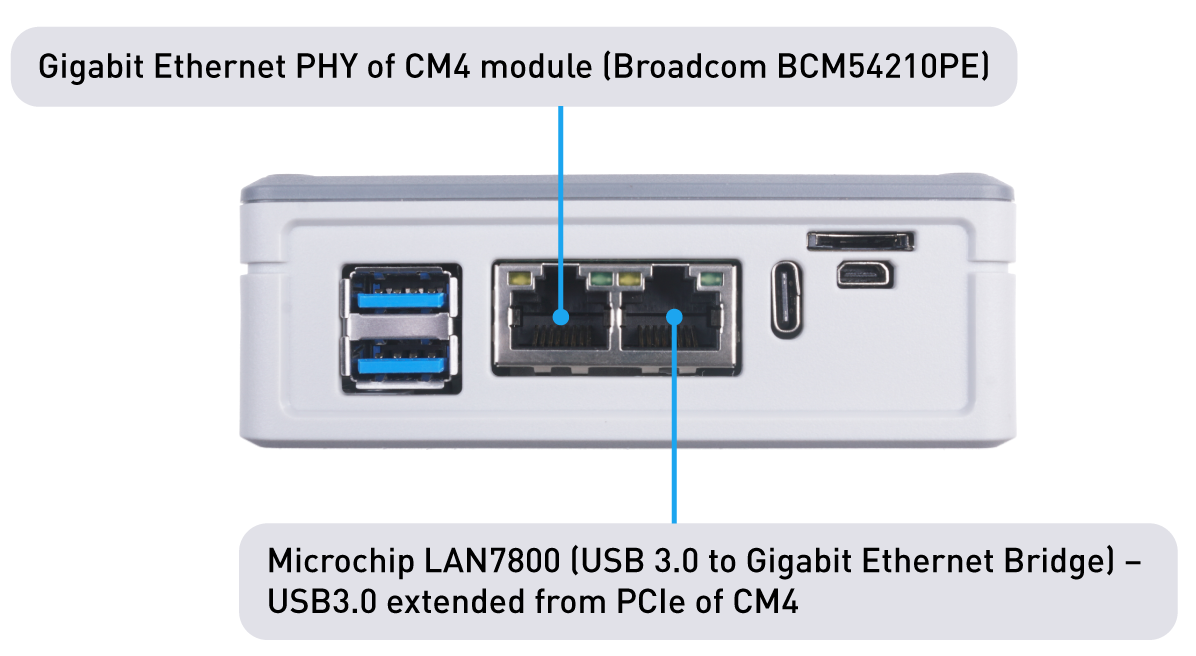
Out of the two Gigabit Ethernet Ports (RJ45), one Ethernet Port is connected to the Gigabit Ethernet PHY of the CM4 module which is based on Broadcom BCM54210PE. On the other hand, the other Gigabit Ethernet Port is connected to Microchip's LAN7800 which is a USB 3.0 to GbE (Gigabit Ethernet Bridge). The USB 3.0 interface here is extended from the PCIe interface of the CM4 Module. Also, both ports can support speeds up to 1Gbps.
It features a variety of I/O peripherals such as MIPI CSI, MIPI DSI, micro-HDMI to connect displays/ cameras, a standard 9-pin USB 3.0 header for more USB expansion, a micro-SD card slot, and an FPC connector while maintaining a compact form factor! This board is ideal for HTPC makers, Linux developers, software router enthusiasts, and the majority of regular Raspberry Pi users.
Also, this comes included with a PC/ABS case with an Aluminum alloy on top which has a large sink in order to cool down the CM4 at extreme loads. It provides better protection as well and is suitable to be used in industrial applications.
Heat Maps

The case has long rubber feet for better stability when placed on a flat surface. You can mount this case in two different methods. One is to use the keyhole slot wall mount and hang it on the wall (you can hang in 2 different orientations). The other is to use the 3 mounting holes and mount onto a DIN rail.
Wall Mount (horizontal and vertical orientations)

DIN Rail Mount

OpenWrt Pre-Installed
The Compute Module 4 comes with OpenWrt firmware pre-installed out-of-the-box. This means you just need to unbox the package, take out the board, connect to your existing home network and have your own mini router!

OpenWrt is an open-source Linux operating system which runs on embedded devices/ routers. It offers more features, performance, and security than a traditional router. It has a filesystem that’s fully writable and includes a package management system. You can make use of these packages to suit your applications in various ways. Once you connect this board to your home network and access the router from a web browser, you will be presented with a beautiful and interactive dashboard as follows.
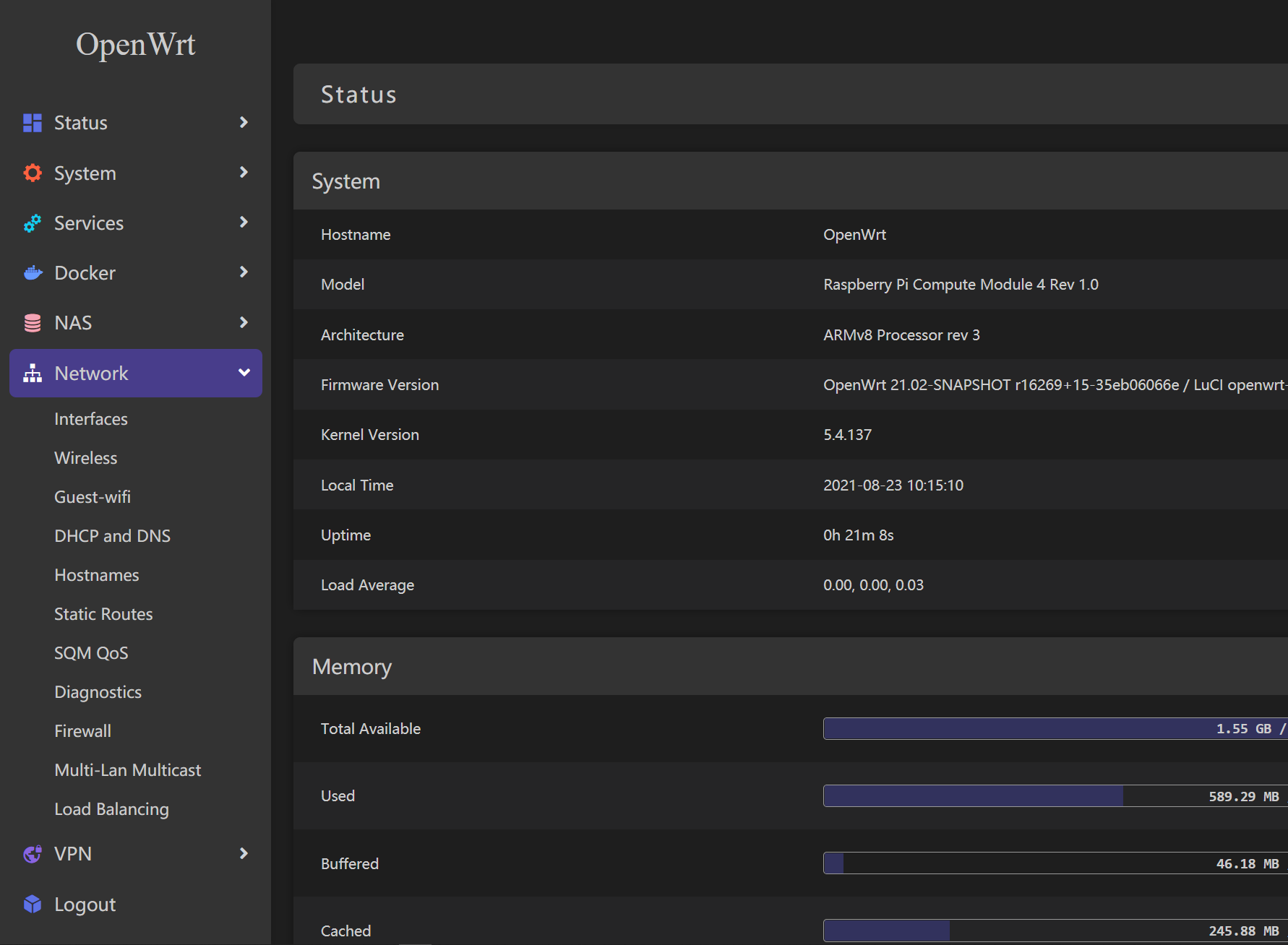
You can navigate this dashboard, and you will have access to a bunch of features such as:
- Increase overall network performance when multiple devices are connected
- Share files between devices via an external storage drive connected directly to the router
- Increase network security
- Run a BitTorrent client from the router
- Connect a printer directly to the router to create a networked printer
- Limit bandwidth usage of a particular device in the network
- Active queue management
- Real-time network monitoring
- Create Dynamic DNS
- Set Up a VPN client or server
- Block ads on the network
By utilizing the above features, you will have unlimited possibilities with this mini router!
What is a Router?
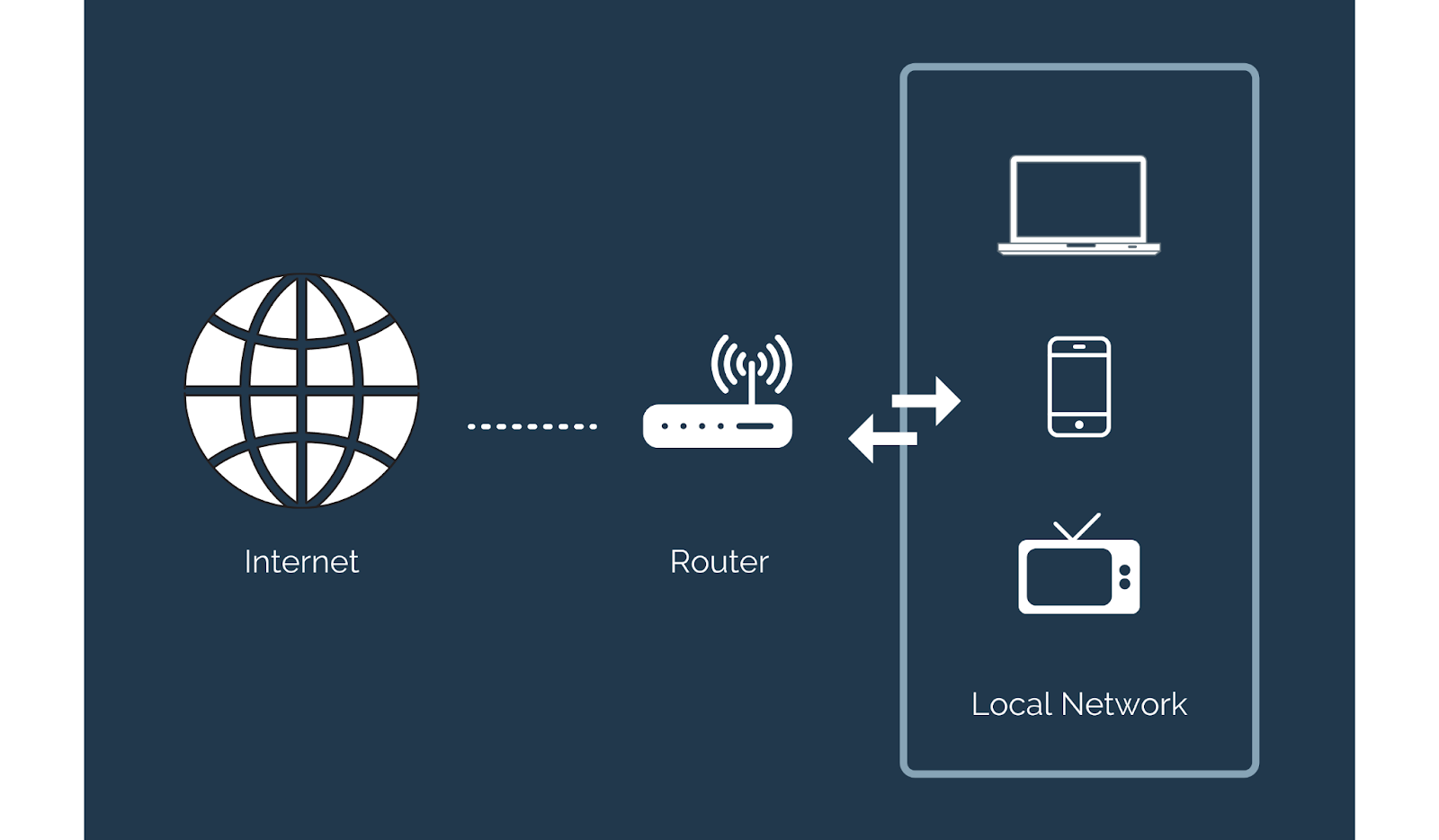
A router is a piece of hardware that connects a Local Area Network (LAN) to other networks. In most cases, this “other network” is known as a Wide Area Network (WAN), or none other than the Internet. The router is very much the “administrator” of this local network and plays an important role in managing connected devices. While their primary role is true to simply coordinate connections and forward data, routers are very much small computers themselves.
Why choose Raspberry Pi 4 for the home router?
1. Increase Network Bandwidth and Performance
While the Raspberry Pi is definitely weaker in comparison to a full-fledged desktop or laptop, its Broadcom CPU is certainly more than enough when it comes to network routing. Thus, a Raspberry Pi router will surely be a boost to your network and give you greater internet speeds!
2. Improve Network Security
With a Raspberry Pi Router, you’ll be able to choose from free, open-source operating systems like OpenWrt that are community reviewed and maintained for security!
3. Enjoy Additional Features
With the accompanying hardware and I/O, using a Raspberry Pi as a router grants you flexibility in adding more features.
Read this blog for more details.
Specifications
Carrier Board
| Specification |
Details |
| Networking |
Dual Gigabit Ethernet Connectors |
USB 3.0 to GbE
(Gigabit Ethernet Bridge) |
Microchip's LAN7800 |
| USB |
2 x USB 3.0 Ports
1 x USB 3.0 9-Pin Header |
| Storage |
Micro-SD Card Slot (load system Image for non-eMMC CM4 version) |
| Camera |
1 x MIPI CSI Connector |
| Display |
1 x MIPI DSI Connector
1 x Micro HDMI Connector |
| FPC |
Interface for I2C and SPI |
| External Fan |
Power connector for fan |
| Power |
5V/3A using USB Type-C Port |
LAN7800 Industrial
Temperature Range |
-40°C to +85°C |
| Dimensions |
75x64x21mm |
| Weight |
43g |
Compute Module 4
| Specification |
Details |
| Processor |
Broadcom BCM2711 quad-core Cortex-A72 (ARM v8) 64-bit SoC @ 1.5GHz |
| Memory |
4GB LPDDR4 |
| Storage |
32GB eMMC |
| Connectivity |
2.4GHz and 5.0GHz IEEE 802.11b/g/n/ac Wi-Fi, Bluetooth 5.0, BLE with onboard and external antenna options |
| Onboard Gigabit Ethernet PHY supporting IEEE1588 |
| 1 × USB 2.0 interface |
| PCIe Gen 2 x1 interface |
| 28 GPIO signals |
| SD card interface for SD card or external eMMC |
| Video |
Dual HDMI interface (up to 4Kp60 supported) |
| 2-lane MIPI DSI display interface |
| 2-lane MIPI CSI camera interface |
| 4-lane MIPI DSI display interface |
| 4-lane MIPI CSI camera interface |
| Multimedia |
H.265 (4Kp60 decode); H.264 (1080p60 decode, 1080p30 encode); OpenGL ES 3.0 graphics |
| Input power |
5V DC |
| Operating temperature |
0 to +80°C |
| Dimensions |
55 mm × 40 mm |
| Production lifetime |
Raspberry Pi Compute Module 4 will remain in production until at least January 2028 |
| Compliance |
For a full list of local and regional product approvals, please visit:
www.raspberrypi.org/documentation/hardware/raspberrypi/conformity.md |
Applications
- Software Router
- IoT applications
- Smart Home
- Camera / Video-related Projects
Hardware Overview


